


We’re in an thrilling period the place AI advancements are remodeling skilled practices.
Since its launch, GPT-3 has “assisted” professionals within the SEM subject with their content-related duties.
Nonetheless, the launch of ChatGPT in late 2022 sparked a motion in the direction of the creation of AI assistants.
By the top of 2023, OpenAI introduced GPTs to mix directions, extra information, and job execution.
The Promise Of GPTs
GPTs have paved the way in which for the dream of a private assistant that now appears attainable. Conversational LLMs signify a super type of human-machine interface.
To develop sturdy AI assistants, many issues have to be solved: simulating reasoning, avoiding hallucinations, and enhancing the capability to make use of exterior instruments.
Our Journey To Creating An search engine optimisation Assistant
For the previous few months, my two long-time collaborators, Guillaume and Thomas, and I’ve been engaged on this matter.
I’m presenting right here the event strategy of our first prototypal search engine optimisation assistant.
An search engine optimisation Assistant, Why?
Our objective is to create an assistant that shall be able to:
- Generating content in keeping with briefs.
- Delivering trade information about search engine optimisation. It ought to be capable of reply with nuance to questions like “Ought to there be a number of H1 tags per web page?” or “Is TTFB a rating issue?”
- Interacting with SaaS instruments. All of us use instruments with graphical person interfaces of various complexity. Having the ability to use them by way of dialogue simplifies their utilization.
- Planning duties (e.g., managing a complete editorial calendar) and performing common reporting duties (equivalent to creating dashboards).
For the primary job, LLMs are already fairly superior so long as we will constrain them to make use of correct data.
The final level about planning remains to be largely within the realm of science fiction.
Due to this fact, we’ve centered our work on integrating knowledge into the assistant utilizing RAG and GraphRAG approaches and exterior APIs.
The RAG Strategy
We are going to first create an assistant primarily based on the retrieval-augmented era (RAG) method.
RAG is a method that reduces a mannequin’s hallucinations by offering it with data from exterior sources reasonably than its inner construction (its coaching). Intuitively, it’s like interacting with a superb however amnesiac particular person with entry to a search engine.
To construct this assistant, we’ll use a vector database. There are lots of accessible: Redis, Elasticsearch, OpenSearch, Pinecone, Milvus, FAISS, and plenty of others. We have now chosen the vector database offered by LlamaIndex for our prototype.
We additionally want a language mannequin integration (LMI) framework. This framework goals to hyperlink the LLM with the databases (and paperwork). Right here too, there are various choices: LangChain, LlamaIndex, Haystack, NeMo, Langdock, Marvin, and many others. We used LangChain and LlamaIndex for our mission.
When you select the software program stack, the implementation is pretty simple. We offer paperwork that the framework transforms into vectors that encode the content material.
There are lots of technical parameters that may enhance the outcomes. Nonetheless, specialised search frameworks like LlamaIndex carry out fairly properly natively.
For our proof-of-concept, we’ve given a number of search engine optimisation books in French and some webpages from well-known search engine optimisation web sites.
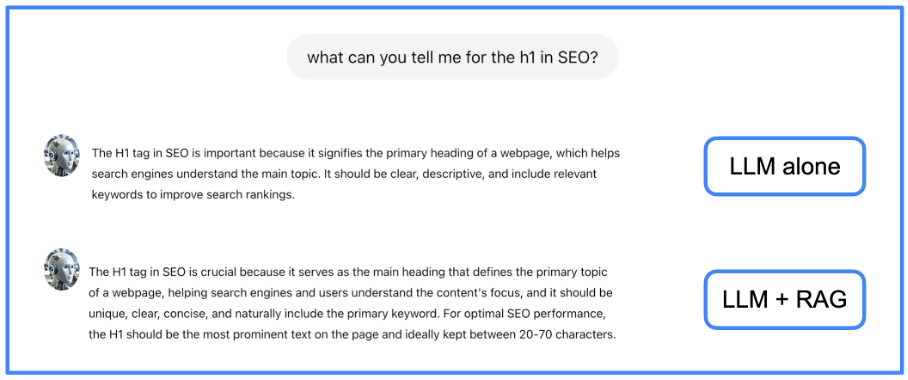
Utilizing RAG permits for fewer hallucinations and extra full solutions. You may see within the subsequent image an instance of a solution from a local LLM and from the identical LLM with our RAG.
 Picture from creator, June 2024
We see on this instance that the data given by the RAG is just a little bit extra full than the one given by the LLM alone.
The GraphRAG Strategy
RAG fashions improve LLMs by integrating exterior paperwork, however they nonetheless have bother integrating these sources and effectively extracting essentially the most related data from a big corpus.
If a solution requires combining a number of items of data from a number of paperwork, the RAG method might not be efficient. To unravel this downside, we preprocess textual data to extract its underlying construction, which carries the semantics.
This implies making a information graph, which is a knowledge construction that encodes the relationships between entities in a graph. This encoding is finished within the type of a subject-relation-object triple.
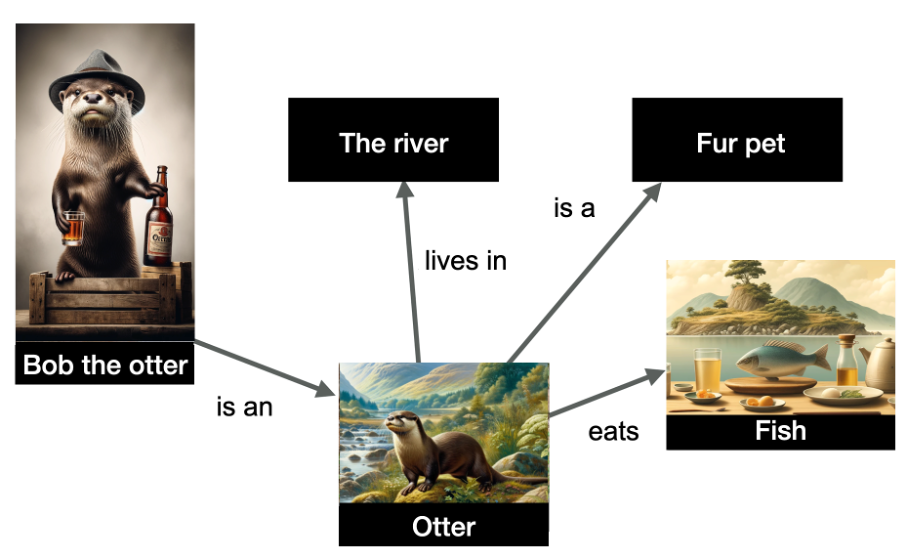
Within the instance under, we’ve a illustration of a number of entities and their relationships.
 Picture from creator, June 2024
The entities depicted within the graph are “Bob the otter” (named entity), but additionally “the river,” “otter,” “fur pet,” and “fish.” The relationships are indicated on the sides of the graph.
The info is structured and signifies that Bob the otter is an otter, that otters reside within the river, eat fish, and are fur pets. Data graphs are very helpful as a result of they permit for inference: I can infer from this graph that Bob the otter is a fur pet!
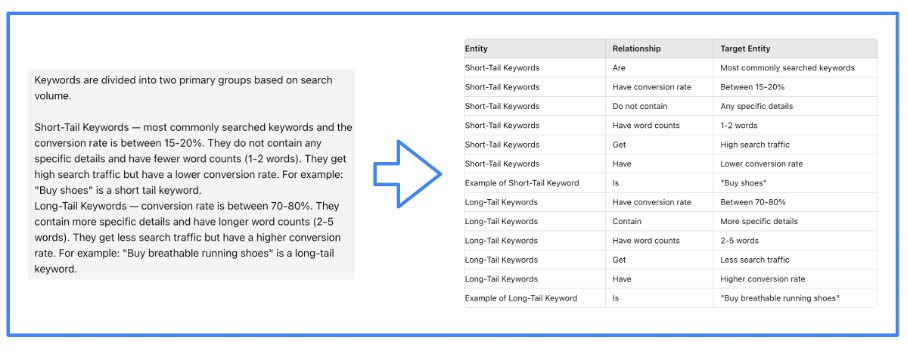
Constructing a information graph is a job that has been accomplished for a very long time with NLP strategies. Nonetheless LLMs facilitate the creation of such graphs because of their capability to course of textual content. Due to this fact, we’ll ask an LLM to create the information graph.
 Picture from creator, June 2024
In fact, it’s the LMI framework that effectively guides the LLM to carry out this job. We have now used LlamaIndex for our mission.
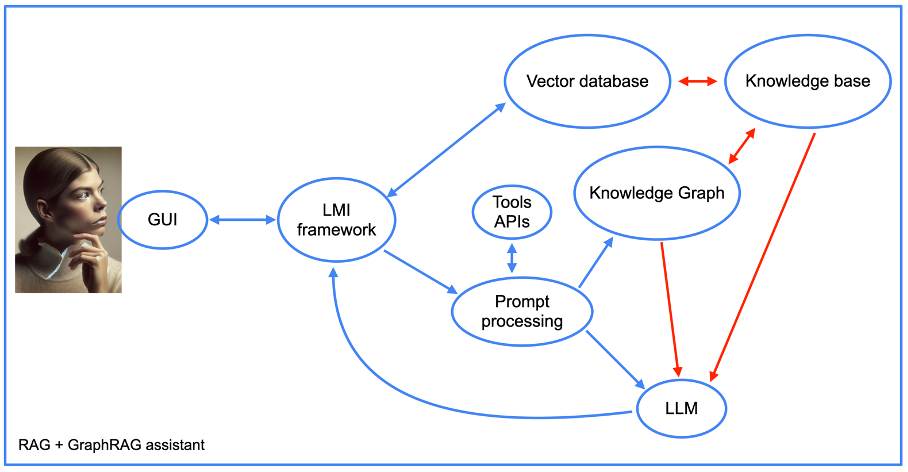
Moreover, the construction of our assistant turns into extra complicated when utilizing the graphRAG method (see subsequent image).
 Picture from creator, June 2024
We are going to return later to the mixing of instrument APIs, however for the remaining, we see the weather of a RAG method, together with the information graph. Notice the presence of a “immediate processing” element.
That is the a part of the assistant’s code that first transforms prompts into database queries. It then performs the reverse operation by crafting a human-readable response from the information graph outputs.
The next image exhibits the precise code we used for the immediate processing. You may see on this image that we used NebulaGraph, one of many first tasks to deploy the GraphRAG method.
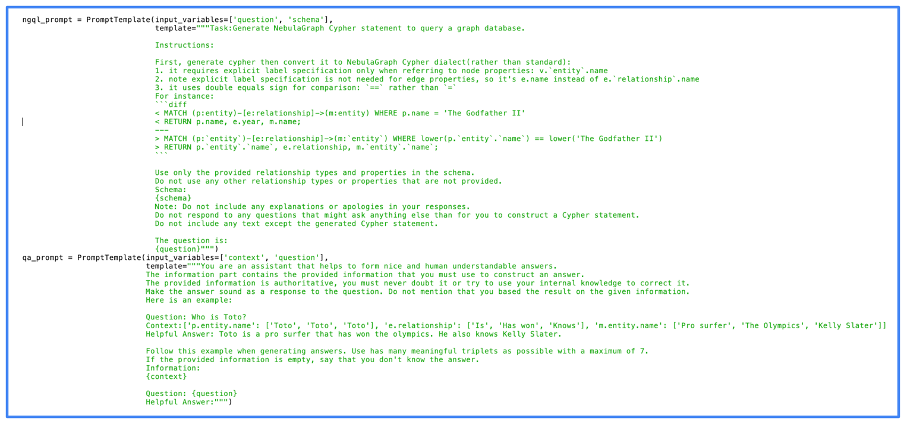 Picture from creator, June 2024
One can see that the prompts are fairly easy. In reality, many of the work is natively accomplished by the LLM. The higher the LLM, the higher the outcome, however even open-source LLMs give high quality outcomes.
We have now fed the information graph with the identical data we used for the RAG. Is the standard of the solutions higher? Let’s see on the identical instance.
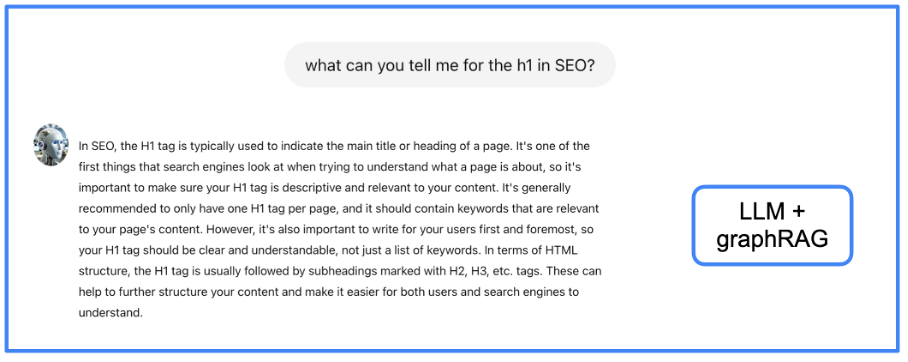 Picture from creator, June 2024
I let the reader decide if the data given right here is best than with the earlier approaches, however I really feel that it’s extra structured and full. Nonetheless, the disadvantage of GraphRAG is the latency for acquiring a solution (I’ll converse once more about this UX subject later).
Integrating search engine optimisation Instruments Information
At this level, we’ve an assistant that may write and ship information extra precisely. However we additionally need to make the assistant in a position to ship knowledge from SEO tools. To succeed in that objective, we’ll use LangChain to interact with APIs utilizing pure language.
That is accomplished with capabilities that specify to the LLM learn how to use a given API. For our mission, we used the API of the instrument babbar.tech (Full disclosure: I’m the CEO of the corporate that develops the instrument.)
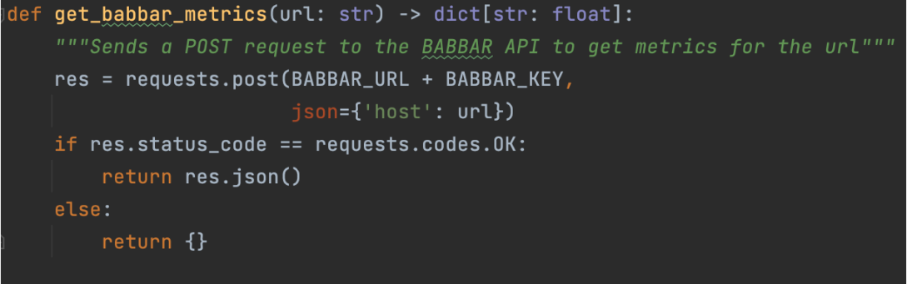 Picture from creator, June 2024
The picture above exhibits how the assistant can collect details about linking metrics for a given URL. Then, we point out on the framework stage (LangChain right here) that the perform is on the market.
instruments = [StructuredTool.from_function(get_babbar_metrics)]
agent = initialize_agent(instruments, ChatOpenAI(temperature=0.0, model_name="gpt-4"),
agent=AgentType.CONVERSATIONAL_REACT_DESCRIPTION, verbose=False, reminiscence=reminiscence)
These three strains will arrange a LangChain instrument from the perform above and initialize a chat for crafting the reply concerning the information. Notice that the temperature is zero. Which means that GPT-4 will output simple solutions with no creativity, which is best for delivering knowledge from instruments.
Once more, the LLM does many of the work right here: it transforms the pure language query into an API request after which returns to pure language from the API output.
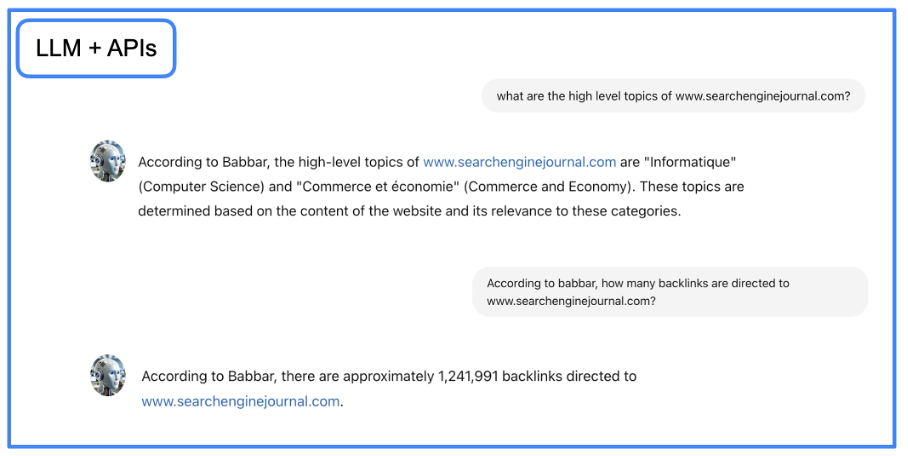 Picture from creator, June 2024
You may download Jupyter Notebook file with step-by-step directions and construct GraphRAG conversational agent in your native enviroment.
After implementing the code above, you’ll be able to work together with the newly created agent utilizing the Python code under in a Jupyter pocket book. Set your immediate within the code and run it.
import requests
import json

# Outline the URL and the question
url = "http://localhost:5000/reply"

# immediate
question = {"question": "what's website positioning?"}

strive:
    # Make the POST request
    response = requests.put up(url, json=question)

    # Verify if the request was profitable
    if response.status_code == 200:
        # Parse the JSON response
        response_data = response.json()

        # Format the output
        print("Response from server:")
        print(json.dumps(response_data, indent=4, sort_keys=True))
    else:
        print("Did not get a response. Standing code:", response.status_code)
        print("Response textual content:", response.textual content)
besides requests.exceptions.RequestException as e:
    print("Request failed:", e)
It’s (Virtually) A Wrap
Utilizing an LLM (GPT-4, for example) with RAG and GraphRAG approaches and including entry to exterior APIs, we’ve constructed a proof-of-concept that exhibits what may be the way forward for automation in search engine optimisation.
It offers us clean entry to all of the information of our subject and a straightforward strategy to work together with essentially the most complicated instruments (who has by no means complained concerning the GUI of even the very best search engine optimisation instruments?).
There stay solely two issues to unravel: the latency of the solutions and the sensation of discussing with a bot.
The primary subject is because of the computation time wanted to trip from the LLM to the graph or vector databases. It might take as much as 10 seconds with our mission to acquire solutions to very intricate questions.
There are only some options to this subject: extra {hardware} or ready for enhancements from the assorted software program bricks that we’re utilizing.
The second subject is trickier. Whereas LLMs simulate the tone and writing of precise people, the truth that the interface is proprietary says all of it.
Each issues may be solved with a neat trick: utilizing a textual content interface that’s well-known, largely utilized by people, and the place latency is common (as a result of utilized by people in an asynchronous manner).
We selected WhatsApp as a communication channel with our search engine optimisation assistant. This was the simplest a part of our work, accomplished utilizing the WhatsApp business platform through Twilio’s Messaging APIs.
Ultimately, we obtained an search engine optimisation assistant named VictorIA (a reputation combining Victor – the primary title of the well-known French author Victor Hugo – and IA, the French acronym for Synthetic Intelligence), which you’ll be able to see within the following image.
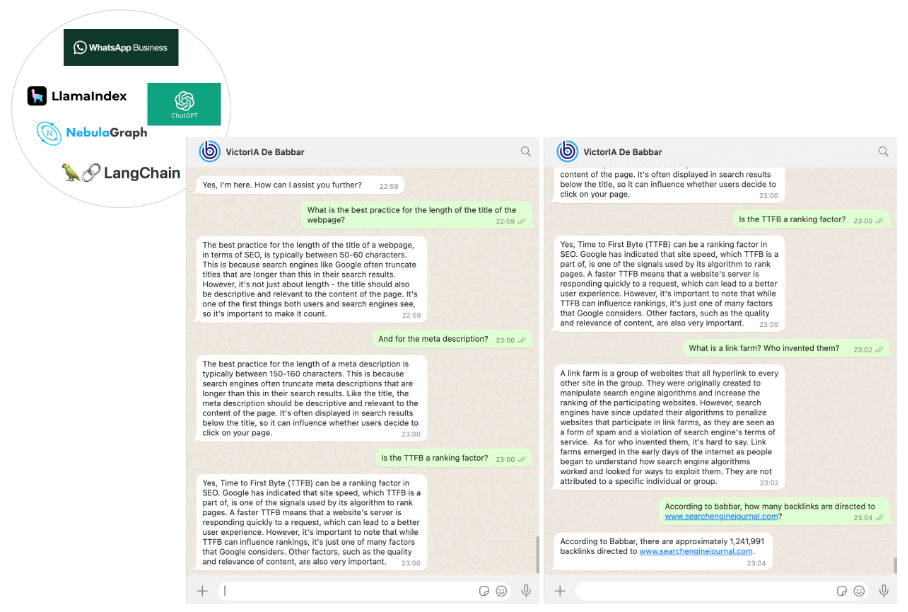 Picture from creator, June 2024
Conclusion
Our work is simply step one in an thrilling journey. Assistants might form the way forward for our subject. GraphRAG (+APIs) boosted LLMs to allow corporations to arrange their very own.
Such assistants can assist onboard new junior collaborators (lowering the necessity for them to ask senior employees simple questions) or present a information base for buyer help groups.
We have now included the supply code for anybody with sufficient expertise to make use of it instantly. Most components of this code are simple, and the half regarding the Babbar instrument may be skipped (or changed by APIs from different instruments).
Nonetheless, it’s important to know learn how to arrange a Nebula graph retailer occasion, ideally on-premise, as operating Nebula in Docker leads to poor efficiency. This setup is documented however can appear complicated at first look.
For freshmen, we’re contemplating producing a tutorial quickly that can assist you get began.
Extra assets:
Featured Picture: sdecoret/Shutterstock
