


Cumulative Format Shift (CLS) is a Google Core Web Vitals metric that measures a consumer expertise occasion.
CLS grew to become a rating consider 2021 and which means it’s necessary to know what it’s and the best way to optimize for it.
What Is Cumulative Format Shift?
CLS is the sudden shifting of webpage parts on a web page whereas a consumer is scrolling or interacting on the web page
The sorts of parts that are likely to trigger shift are fonts, photos, movies, contact types, buttons, and different kinds of content material.
Minimizing CLS is necessary as a result of pages that shift round may cause a poor consumer expertise.
A poor CLS rating (beneath > 0.1 ) is indicative of coding points that may be solved.
What Causes CLS Points?
There are 4 the explanation why Cumulative Format Shift occurs:
- Photographs with out dimensions.
- Advertisements, embeds, and iframes with out dimensions.
- Dynamically injected content material.
- Internet Fonts inflicting FOIT/FOUT.
- CSS or JavaScript animations.
Photographs and movies should have the peak and width dimensions declared within the HTML. For responsive photos, be sure that the totally different picture sizes for the totally different viewports use the identical facet ratio.
Let’s dive into every of those components to know how they contribute to CLS.
Photographs With out Dimensions
Browsers can’t decide the picture’s dimensions till they obtain them. In consequence, upon encountering an
As soon as the picture is downloaded, the browser must recalculate the format and allocate area for the picture to suit, which causes different parts on the web page to shift.
By offering width and top attributes within the tag, you inform the browser of the picture’s facet ratio. This permits the browser to allocate the right amount of area within the format earlier than the picture is absolutely downloaded and prevents any sudden format shifts.
Advertisements Can Trigger CLS
If you happen to load AdSense adverts within the content material or leaderboard on high of the articles with out correct styling and settings, the format might shift.
This one is just a little difficult to cope with as a result of advert sizes might be totally different. For instance, it might be a 970×250 or 970×90 advert, and in the event you allocate 970×90 area, it might load a 970×250 advert and trigger a shift.
In distinction, in the event you allocate a 970×250 advert and it hundreds a 970×90 banner, there shall be numerous white area round it, making the web page look dangerous.
It’s a trade-off, both you need to load adverts with the identical dimension and profit from elevated stock and better CPMs or load multiple-sized adverts on the expense of consumer expertise or CLS metric.
Dynamically Injected Content material
That is content material that’s injected into the webpage.
For instance, posts on X (previously Twitter), which load within the content material of an article, might have arbitrary top relying on the publish content material size, inflicting the format to shift.
After all, these normally are beneath the fold and don’t rely on the preliminary web page load, but when the consumer scrolls quick sufficient to achieve the purpose the place the X publish is positioned and it hasn’t but loaded, then it would trigger a format shift and contribute into your CLS metric.
One solution to mitigate this shift is to provide the common min-height CSS property to the tweet mum or dad div tag as a result of it’s unimaginable to know the peak of the tweet publish earlier than it hundreds so we will pre-allocate area.
One other solution to repair that is to use a CSS rule to the mum or dad div tag containing the tweet to repair the peak.
#tweet-div {
max-height: 300px;
overflow: auto;
}
Nevertheless, it would trigger a scrollbar to look, and customers should scroll to view the tweet, which is probably not greatest for consumer expertise.
If not one of the steered strategies works, you can take a screenshot of the tweet and hyperlink to it.
Internet-Based mostly Fonts
Downloaded internet fonts may cause what’s referred to as Flash of invisible textual content (FOIT).
A solution to forestall that’s to make use of preload fonts
and utilizing font-display: swap; css property on @font-face at-rule.
@font-face {
   font-family: Inter;
   font-style: regular;
   font-weight: 200 900;
   font-display: swap;
   src: url('https://www.instance.com/fonts/inter.woff2') format('woff2');
}
With these guidelines, you’re loading internet fonts as shortly as doable and telling the browser to make use of the system font till it hundreds the net fonts. As quickly because the browser finishes loading the fonts, it swaps the system fonts with the loaded internet fonts.
Nevertheless, you should still have an impact referred to as Flash of Unstyled Textual content (FOUT), which is unimaginable to keep away from when utilizing non-system fonts as a result of it takes a while till internet fonts load, and system fonts shall be displayed throughout that point.
Within the video beneath, you possibly can see how the title font is modified by inflicting a shift.
The visibility of FOUT is dependent upon the consumer’s connection pace if the advisable font loading mechanism is carried out.
If the consumer’s connection is sufficiently quick, the net fonts might load shortly sufficient and get rid of the noticeable FOUT impact.
Due to this fact, utilizing system fonts at any time when doable is a good strategy, however it might not all the time be doable as a consequence of model model pointers or particular design necessities.
CSS Or JavaScript Animations
When animating HTML parts’ top through CSS or JS, for instance, it expands a component vertically and shrinks by pushing down content material, inflicting a format shift.
To forestall that, use CSS transforms by allocating area for the component being animated. You possibly can see the distinction between CSS animation, which causes a shift on the left, and the identical animation, which makes use of CSS transformation.
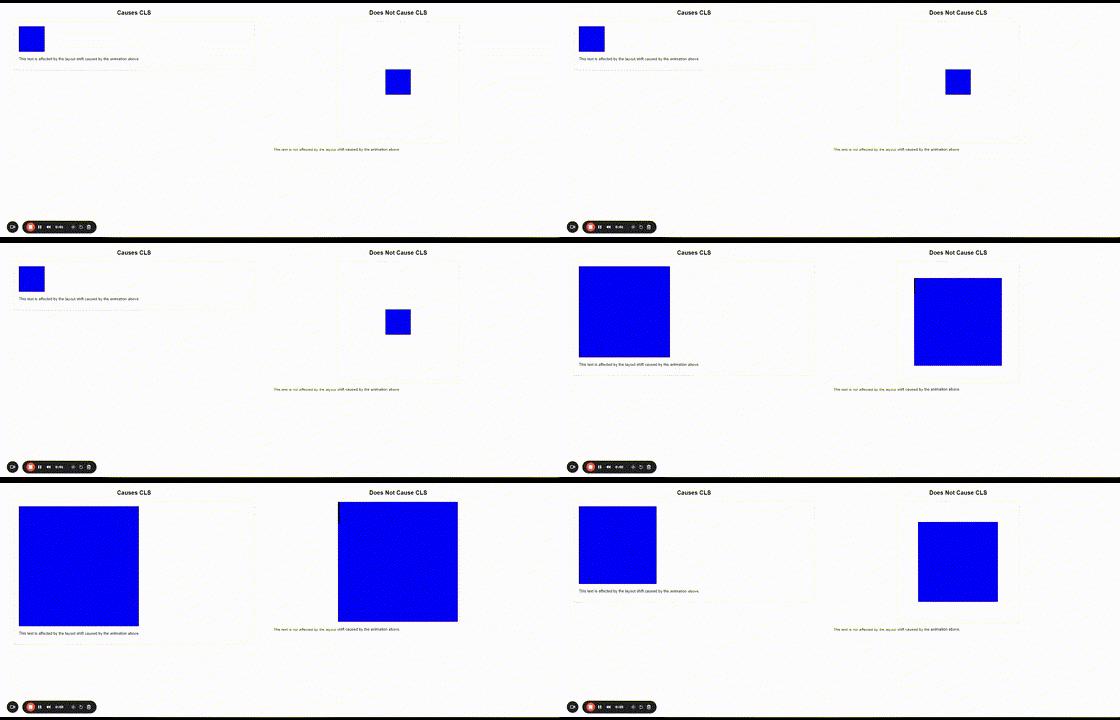 CSS animation instance inflicting CLS
How Cumulative Format Shift Is Calculated
This can be a product of two metrics/occasions referred to as “Affect Fraction” and “Distance Fraction.”
CLS = ( Affect Fraction)×( Distance Fraction)
Affect Fraction
Affect fraction measures how a lot area an unstable component takes up within the viewport.
A viewport is what you see on the cellular display screen.
When a component downloads after which shifts, the entire area that the component occupies, from the situation that it occupied within the viewport when it’s first rendered to the ultimate location when the web page is rendered.
The instance that Google makes use of is a component that occupies 50% of the viewport after which drops down by one other 25%.
When added collectively, the 75% worth is known as the Affect Fraction, and it’s expressed as a rating of 0.75.
Distance Fraction
The second measurement is known as the Distance Fraction. The space fraction is the quantity of area the web page component has moved from the unique to the ultimate place.
Within the above instance, the web page component moved 25%.
So now the Cumulative Format Rating is calculated by multiplying the Affect Fraction by the Distance Fraction:
0.75 x 0.25 = 0.1875
The calculation includes some extra math and different concerns. What’s necessary to remove from that is that the rating is one solution to measure an necessary consumer expertise issue.
Right here is an instance video visually illustrating what impression and distance components are:
Perceive Cumulative Format Shift
Understanding Cumulative Format Shift is necessary, however it’s not essential to know the best way to do the calculations your self.
Nevertheless, understanding what it means and the way it works is essential, as this has change into a part of the Core Internet Vitals rating issue.
Extra sources:
Featured picture credit score: BestForBest/Shutterstock
