


Regardless of important adjustments to the natural search panorama all year long, the pace and effectivity of internet pages have remained paramount.
Customers proceed to demand fast and seamless on-line interactions, with 83% of on-line customers reporting that they count on web sites to load in three seconds or much less.
Google units the bar even greater, requiring a Largest Contentful Paint (a metric used to measure a web page’s loading efficiency) of lower than 2.5 seconds to be thought-about “Good.”
The fact continues to fall beneath each Google’s and customers’ expectations, with the typical web site taking 8.6 seconds to load on cellular gadgets.
On the brilliant aspect, that quantity has dropped 7 seconds since 2018, when it took the typical web page 15 seconds to load on cellular gadgets.
However web page pace isn’t solely about complete web page load time; it’s additionally about what customers expertise in these 3 (or 8.6) seconds. It’s important to think about how effectively pages are rendering.
That is completed by optimizing the important rendering path to get to your first paint as shortly as doable.
Principally, you’re decreasing the period of time customers spend taking a look at a clean white display to show visible content material ASAP (see 0.0s beneath).
What Is The Vital Rendering Path?
The important rendering path refers back to the sequence of steps a browser takes on its journey to render a web page, by changing the HTML, CSS, and JavaScript to precise pixels on the display.
Basically, the browser must request, obtain, and parse all HTML and CSS information (plus some additional work) earlier than it is going to begin to render any visible content material.
Till the browser completes these steps, customers will see a clean white web page.
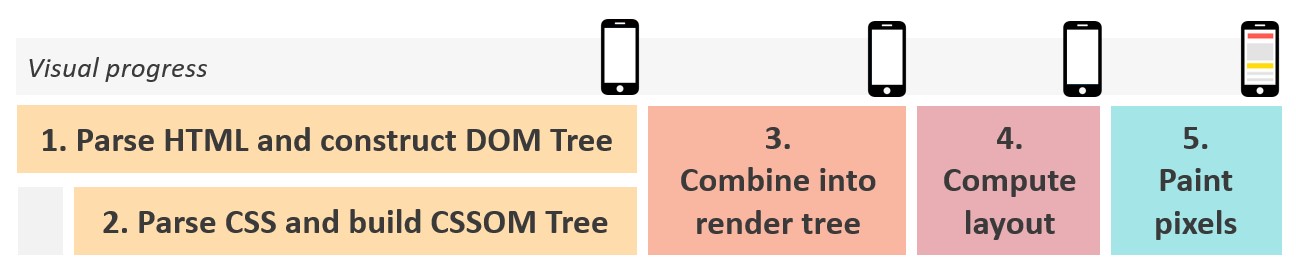 Steps for browser to render visible content material. (Picture created by writer)
How Do I Optimize It?
The first aim of optimizing the important rendering path is to prioritize the assets wanted to render significant, above-the-fold content material.
To do that, we additionally should determine and deprioritize render-blocking assets – assets that aren’t essential to load above-the-fold content material and forestall the web page from rendering as shortly because it might.
To enhance the important rendering path, begin with a list of important assets (any useful resource that blocks the preliminary rendering of the web page) and search for alternatives to:
- Cut back the variety of important assets by deferring render-blocking assets.
- Shorten the important path by prioritizing above-the-fold content material and downloading all important belongings as early as doable.
- Cut back the variety of important bytes by decreasing the file measurement of the remaining important assets.
There’s an entire course of on how to do that, outlined in Google’s developer documentation (thanks, Ilya Grigorik), however I shall be specializing in one heavy hitter specifically: Decreasing render-blocking assets.
What Are Render-Blocking Assets?
Render-blocking assets are components of a webpage that should be absolutely loaded and processed by the browser earlier than it might begin rendering the content material on the display. These assets usually embody CSS (Cascading Type Sheets) and JavaScript information.
Render-Blocking CSS
CSS is inherently render-blocking.
The browser received’t begin to render any web page content material till it is ready to request, obtain, and course of all CSS kinds.
This avoids the destructive consumer expertise that will happen if a browser tried to render un-styled content material.
A web page rendered with out CSS could be nearly unusable, and the bulk (if not all) of content material would should be repainted.
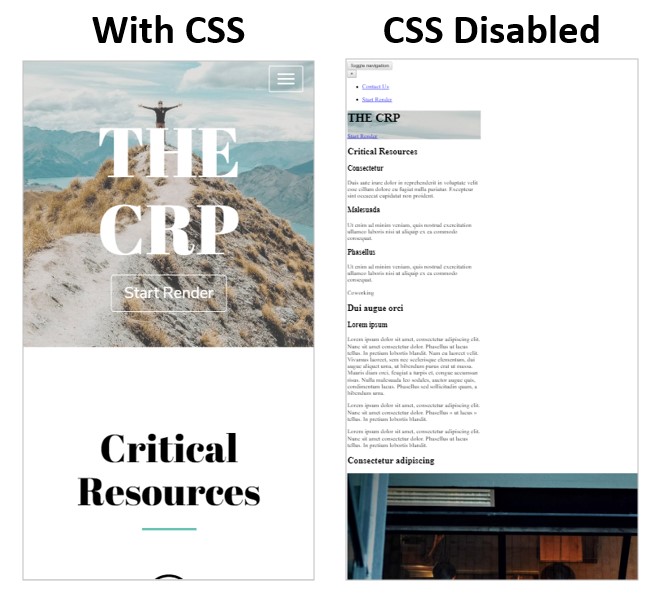 Instance web page with and with out CSS, (Picture created by writer)
Trying again to the web page rendering course of, the grey field represents the time it takes the browser to request and obtain all CSS assets so it might start to assemble the CCSOM tree (the DOM of CSS).
The time it takes the browser to perform this could differ significantly, relying on the quantity and measurement of CSS assets.
 Steps for browser to render visible content material. (Picture created by writer)
“CSS is a render-blocking useful resource. Get it to the consumer as quickly and as shortly as doable to optimize the time to first render.”
Render-Blocking JavaScript
In contrast to CSS, the browser doesn’t have to obtain and parse all JavaScript assets to render the web page, so it’s not technically* a “required” step (*most fashionable web sites require JavaScript for his or her above-the-fold expertise).
But, when the browser encounters JavaScript earlier than the preliminary render of the web page, the web page rendering course of is paused till after the JavaScript is executed (except in any other case specified utilizing the defer or async attributes – extra on that later).
For instance, including a JavaScript alert operate into the HTML blocks web page rendering till the JavaScript code is completed executing (once I click on “OK” within the display recording beneath).
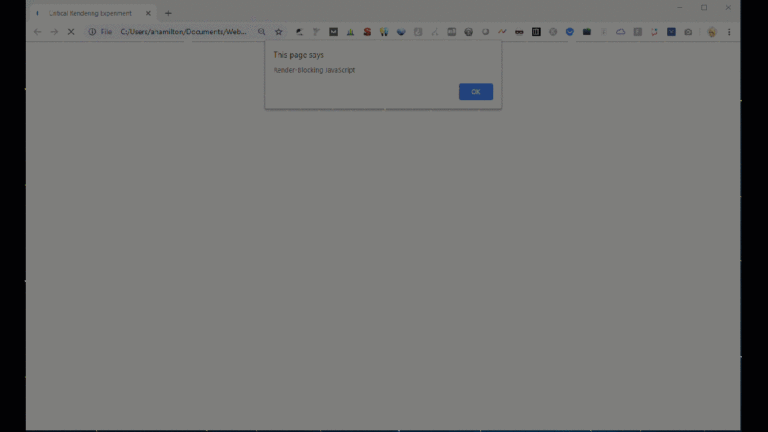 Instance of render-blocking JavaScript. (Picture created by writer)
It’s because JavaScript has the facility to govern web page (HTML) components and their related (CSS) kinds.
For the reason that JavaScript might theoretically change the whole content material on the web page, the browser pauses HTML parsing to obtain and execute the JavaScript simply in case.
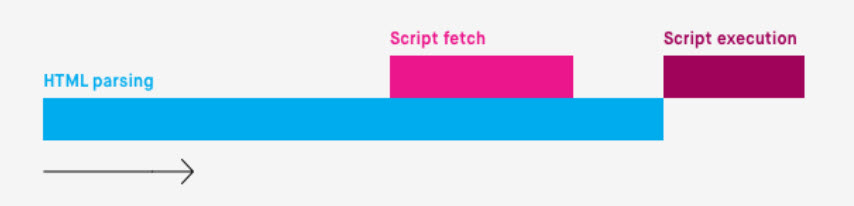 How the browser handles JavaScript, (Picture from Bits of Code, August 2024)
“JavaScript also can block DOM development and delay when the web page is rendered. To ship optimum efficiency … get rid of any pointless JavaScript from the important rendering path.”
How Do Render Blocking Assets Affect Core Net Vitals?
Core Web Vitals (CWV) is a set of web page expertise metrics created by Google to extra precisely measure an actual consumer’s expertise of a web page’s loading efficiency, interactivity, and visible stability.
The present metrics used right this moment are:
- Largest Contentful Paint (LCP): Used to guage loading efficiency, LCP measures the time it takes for the biggest seen content material aspect (corresponding to a picture or block of textual content) to seem on the display.
- Interplay to Subsequent Paint (INP): Used to guage responsiveness, INP measures the time from when a consumer interacts with the web page (e.g., clicks a button or a hyperlink) to the time when the browser is ready to answer that interplay.
- Cumulative Structure Shift (CLS): Used to guage visible stability, CLS measures the sum complete of all sudden structure shifts that happen throughout the whole lifespan of the web page. A decrease CLS rating signifies that the web page is steady and gives a greater consumer expertise.
Optimizing the important rendering path will usually have the biggest impression on Largest Contentful Paint (LCP) because it’s particularly centered on how lengthy it takes for pixels to seem on the display.
The important rendering path impacts LCP by figuring out how shortly the browser can render essentially the most important content material components. If the important rendering path is optimized, the biggest content material aspect will load quicker, leading to a decrease LCP time.
Learn Google’s information on how to optimize Largest Contentful Paint to study extra about how the important rendering path impacts LCP.
Optimizing the important rendering path and decreasing render blocking assets also can profit INP and CLS within the following methods:
- Enable for faster interactions. A streamlined important rendering path helps scale back the time the browser spends on parsing and executing JavaScript, which might block consumer interactions. Making certain scripts load effectively can enable for fast response occasions to consumer interactions, enhancing INP.
- Guarantee assets are loaded in a predictable method. Optimizing the important rendering path helps guarantee components are loaded in a predictable and environment friendly method. Successfully managing the order and timing of useful resource loading can forestall sudden structure shifts, enhancing CLS.
To get an concept of what pages would profit essentially the most from decreasing render-blocking assets, view the Core Web Vitals report in Google Search Console. Focus the following steps of your evaluation on pages the place LCP is flagged as “Poor” or “Want Enchancment.”
How To Determine Render-Blocking Assets
Earlier than we are able to scale back render-blocking assets, we’ve to determine all of the potential suspects.
Fortunately, we’ve a number of instruments at our disposal to shortly pinpoint precisely which assets are hindering optimum web page rendering.
PageSpeed Insights & Lighthouse
PageSpeed Insights and Lighthouse supply a fast and straightforward technique to determine render blocking assets.
Merely take a look at a URL in both instrument, navigate to “Remove render-blocking assets” below “Diagnostics,” and develop the content material to see a listing of first-party and third-party assets blocking the primary paint of your web page.
Each instruments will flag two kinds of render-blocking assets:
- JavaScript assets which are in of the doc and don’t have a
or attribute. - CSS assets that shouldn’t have a disabled attribute or a media attribute that matches the consumer’s machine kind.
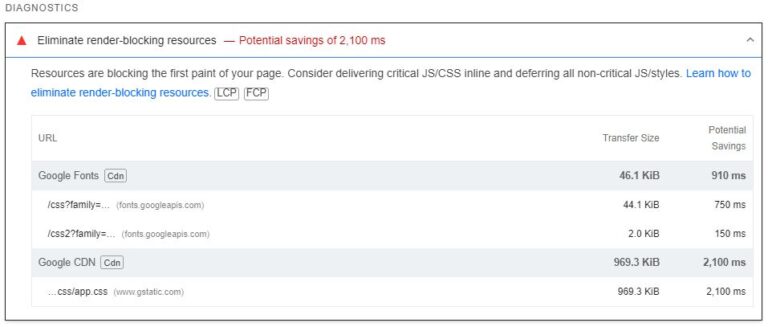 Pattern outcomes from PageSpeed Insights take a look at. (Screenshot by writer, August 2024)
Tip: Use the PageSpeed Insights API in Screaming Frog to check a number of pages without delay.
WebPageTest.org
If you wish to see a visible of precisely how assets had been loaded in and which of them could also be blocking the preliminary web page render, use WebPageTest.org.
To determine important assets:
- Run a take a look at utilizing webpagetest.org and click on on the “waterfall” picture.
- Deal with all assets requested and downloaded earlier than the inexperienced “Begin Render” line.
Analyze your waterfall view; search for CSS or JavaScript information which are requested earlier than the inexperienced “begin render” line however aren’t important for loading above-the-fold content material.
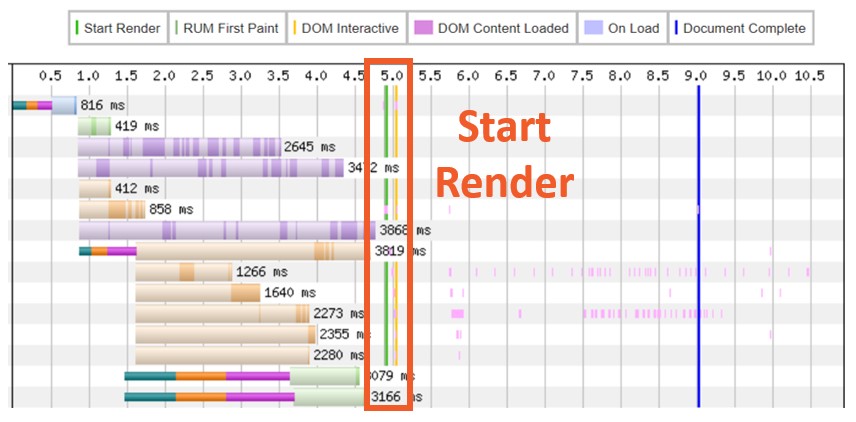 Pattern outcomes from WebPageTest.org. (Screenshot by writer, August 2024)
How To Check If A Useful resource Is Vital To Above-The-Fold Content material
Relying on how good you’ve been to the dev staff currently, you might be able to cease right here and simply merely cross alongside a listing of render-blocking assets in your growth staff to analyze.
Nonetheless, if you happen to’re seeking to rating some additional factors, you may take a look at eradicating the (probably) render-blocking assets to see how above-the-fold content material is affected.
For instance, after finishing the above assessments I seen some JavaScript requests to the Google Maps API that don’t look like important.
 Pattern outcomes from WebPageTest.org. (Screenshot bu writer, August 2024)
To check throughout the browser how deferring these assets would have an effect on above-the-fold content material:
- Open the web page in a Chrome Incognito Window (greatest observe for web page pace testing, as Chrome extensions can skew outcomes, and I occur to be a collector of Chrome extensions).
- Open Chrome DevTools (ctrl+shift+i) and navigate to the “Request blocking” tab in the Network panel.
- Examine the field subsequent to “Allow request blocking” and click on the plus signal.
- Kind a sample to dam the useful resource(s) you’ve recognized, being as particular as doable (utilizing * as a wildcard).
- Click on “Add” and refresh the web page.
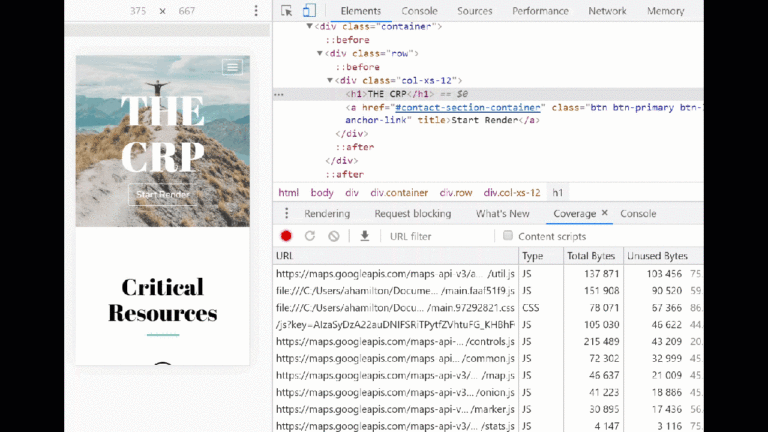 Instance of request blocking utilizing Chrome Developer Instruments. (Picture created by writer, August 2024)
If above-the-fold content material seems the identical after refreshing the web page – the useful resource you examined is probably going candidate for techniques listed below “Strategies to scale back render-blocking assets.”
If the above-the-fold content material doesn’t correctly load, check with the beneath strategies to prioritize important assets.
Strategies To Cut back Render-Blocking
Upon getting confirmed {that a} useful resource shouldn’t be important to rendering above-the-fold content material, discover completely different strategies for deferring assets and enhancing web page rendering.
| Technique | Affect | Works with |
| JavaScript on the backside of the HTML | Low | JS |
| Async or defer attribute | Medium | JS |
| Customized Options | Excessive | JS/CSS |
| CSS media queries | Low-Excessive | CSS |
Place JavaScript At The Backside Of The HTML
When you’ve ever taken a Net Design 101 course, this one could also be acquainted: Place hyperlinks to CSS stylesheets on the prime of the HTML
and place hyperlinks to exterior scripts on the backside of the HTML .
To return to my instance utilizing a JavaScript alert operate, the upper up the operate is within the HTML, the earlier the browser will obtain and execute it.
When the JavaScript alert operate is positioned on the prime of the HTML, web page rendering is straight away blocked, and no visible content material seems on the web page.
 Instance of JavaScript positioned on the prime of the HTML, web page rendering is straight away blocked by the alert operate and no visible content material renders.
When the JavaScript alert operate is moved to the underside of the HTML, some visible content material seems on the web page earlier than web page rendering is blocked.
 Instance of JavaScript positioned on the backside of the HTML, some visible content material seems earlier than web page rendering is blocked by the alert operate.
Whereas putting JavaScript assets on the backside of the HTML stays a typical greatest observe, the tactic by itself is sub-optimal for eliminating render-blocking scripts from the important path.
Proceed to make use of this technique for important scripts, however discover different options to actually defer non-critical scripts.
Use The Async Or Defer Attribute
The async attribute alerts to the browser to load JavaScript asynchronously, and fetch the script when assets turn into obtainable (versus pausing HTML parsing).
As soon as the script is fetched and downloaded, HTML parsing is paused whereas the script is executed.
 How the browser handles JavaScript with an async attribute. (Picture from Bits of Code, August 2024)
The defer attribute alerts to the browser to load JavaScript asynchronously (similar because the async attribute) and to attend to execute JavaScript till the HTML parsing is full, leading to extra financial savings.
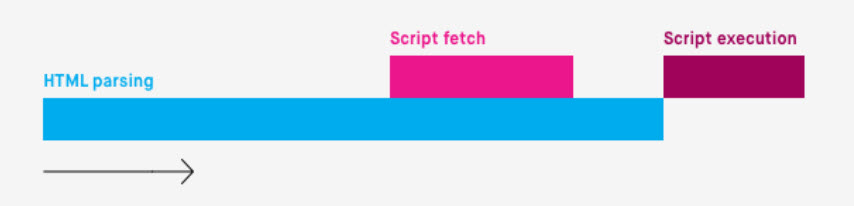 How the browser handles JavaScript with a defer attribute. (Picture from Bits of Code, August 2024)
Each strategies are comparatively simple to implement and assist scale back the time the browser spends parsing HTML (step one in web page rendering) with out considerably altering how content material hundreds on the web page.
Async and defer are good options for the “additional stuff” in your web site (social sharing buttons, a personalised sidebar, social/information feeds, and so on.) which are good to have however don’t make or break the first consumer expertise.
Use A Customized Resolution
Do not forget that annoying JS alert that stored blocking my web page from rendering?
Including a JavaScript operate with an “onload” resolved the issue as soon as and for all; hat tip to Patrick Sexton for the code used beneath.
The script beneath makes use of the onload occasion to name the exterior useful resource “alert.js” solely after all of the preliminary web page content material (all the things else) has completed loading, eradicating it from the important path.
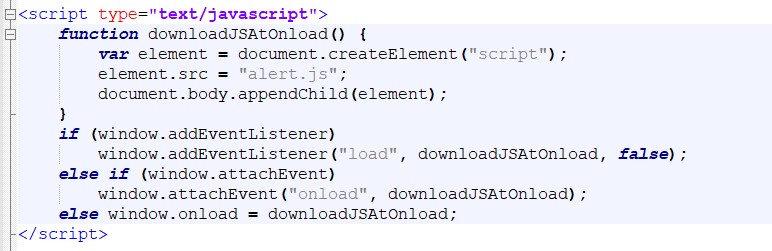 JavaScript onload occasion used to name alert operate
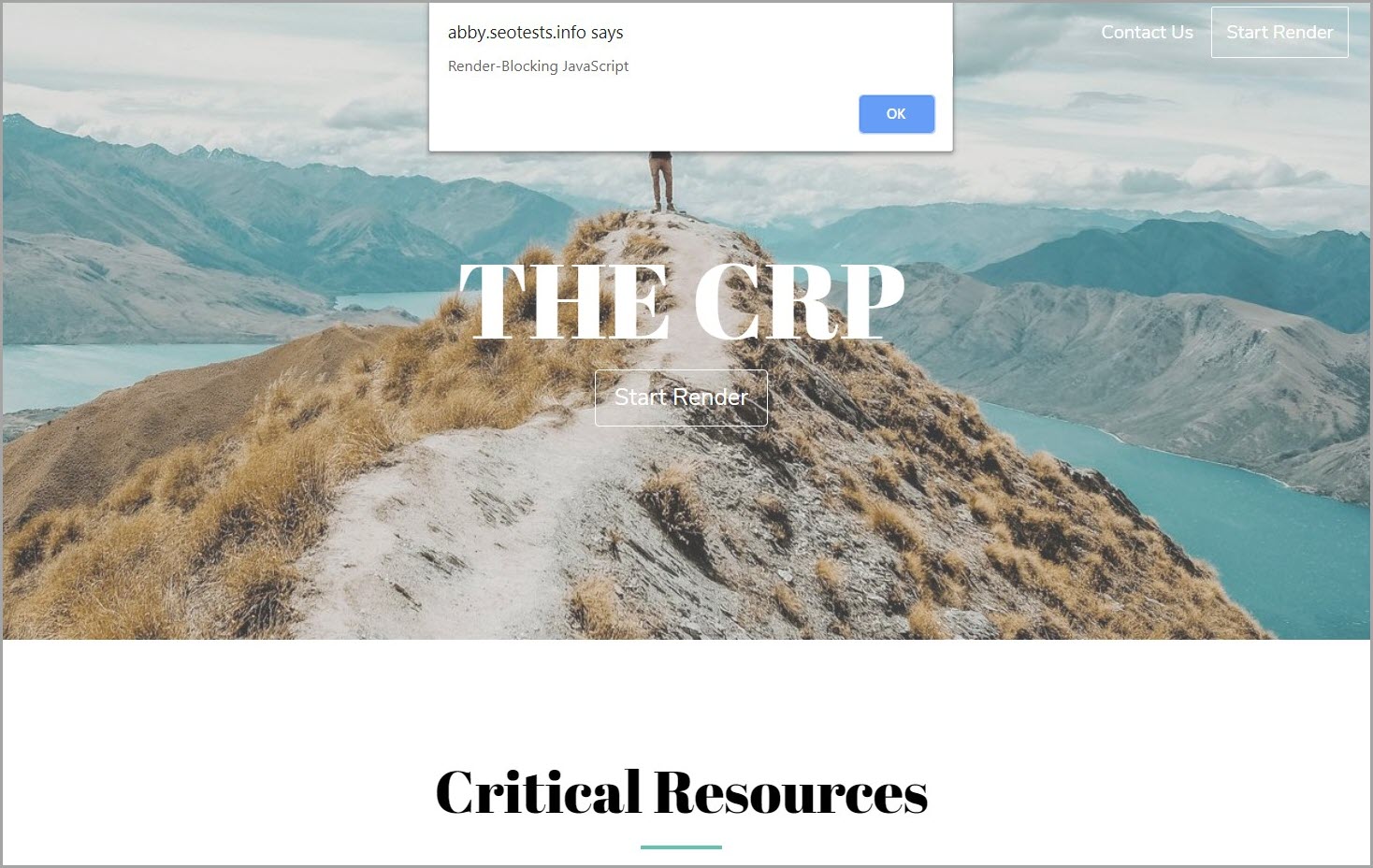 Rendering of visible content material was not blocked when a JavaScript onload occasion was used to name alert operate.
This isn’t a one-size-fits-all resolution. Whereas it might be helpful for the bottom precedence assets (i.e., occasion listeners, components within the footer, and so on.), you’ll most likely want a special resolution for essential content material.
Work along with your growth staff to search out the most effective resolution to enhance web page rendering whereas sustaining an optimum consumer expertise.
Use CSS Media Queries
CSS media queries can unblock rendering by flagging assets which are solely used a number of the time and setting situations on when the browser ought to parse the CSS (primarily based on print, orientation, viewport measurement, and so on.).
All CSS belongings shall be requested and downloaded regardless however with a decrease precedence for non-blocking assets.
 Instance CSS media question that tells the browser to not parse this stylesheet except the web page is being printed.
When doable, use CSS media queries to inform the browser which CSS assets are (and aren’t) important to render the web page.
Strategies To Prioritize Vital Assets
Prioritizing important assets ensures that a very powerful components of a webpage (corresponding to CSS for above-the-fold content material and important JavaScript) are loaded first.
The next strategies might help to make sure your important assets begin loading as early as doable:
- Optimize when critical resources are discovered. Guarantee important assets are discoverable within the preliminary HTML supply code. Keep away from solely referencing important assets in exterior CSS or JavaScript information, as this creates critical request chains that improve the variety of requests the browser has to make earlier than it might even start to obtain the asset.
- Use resource hints to guide browsers. Useful resource hints inform browsers how one can load and prioritize assets. For instance, you might think about using the preload attribute on fonts and hero pictures to make sure they’re obtainable because the browser begins rendering the web page.
- Considering inlining critical styles and scripts. Inlining important CSS and JavaScript with the HTML supply code reduces the variety of HTTP requests the browser has to make to load important belongings. This system ought to be reserved for small, important items of CSS and JavaScript, as giant quantities of inline code can negatively impression the preliminary web page load time.
Along with when the assets load, we must also take into account how lengthy it takes the assets to load.
Decreasing the variety of important bytes that should be downloaded will additional scale back the period of time it takes for content material to be rendered on the web page.
To cut back the dimensions of important assets:
- Minify CSS and JavaScript. Minification removes pointless characters (like whitespace, feedback, and line breaks), decreasing the dimensions of important CSS and JavaScript information.
- Enable text compression: Compression algorithms like Gzip or Brotli can be utilized to additional scale back the dimensions of CSS and JavaScript information to enhance load occasions.
- Remove unused CSS and JavaScript. Eradicating unused code reduces the general measurement of CSS and JavaScript information, lowering the quantity of knowledge that must be downloaded. Be aware, that eradicating unused code is usually an enormous enterprise, requiring considerably extra effort than the above strategies.
TL;DR
- The important rendering path contains the sequence of steps a browser takes to transform HTML, CSS, and JavaScript into visible content material on the web page.
- Optimizing this path can lead to quicker load occasions, improved consumer expertise, and elevated Core Net Vitals scores.
- Instruments like PageSpeed Insights, Lighthouse, and WebPageTest.org assist determine probably render-blocking assets.
- Defer and async HTML attributes could be leveraged to scale back the variety of render-blocking assets.
- Useful resource hints might help guarantee important belongings are downloaded as early as doable.
Extra assets:
Featured Picture: Summit Artwork Creations/Shutterstock
