


Lots has been mentioned concerning the outstanding alternatives of Generative AI (GenAI), and a few of us have additionally been extraordinarily vocal concerning the dangers related to utilizing this transformative expertise.
The rise of GenAI presents vital challenges to the standard of data, public discourse, and the overall open net. GenAI’s energy to foretell and personalize content material could be simply misused to control what we see and interact with.
Generative AI serps are contributing to the general noise, and somewhat than serving to folks discover the reality and forge unbiased opinions, they have a tendency (at the very least of their current implementation) to advertise effectivity over accuracy, as highlighted by a latest study by Jigsaw, a unit inside Google.
Regardless of the hype surrounding Web optimization alligator events and content material goblins, our era of entrepreneurs and Web optimization professionals has spent years working in the direction of a extra optimistic net setting.
We’ve shifted the advertising focus from manipulating audiences to empowering them with knowledge, finally aiding stakeholders in making knowledgeable choices.
Creating an ontology for Web optimization is a community-led effort that aligns completely with our ongoing mission to form, enhance, and supply instructions that actually advance human-GenAI interplay whereas preserving content material creators and the Internet as a shared useful resource for data and prosperity.
Conventional Web optimization practices within the early 2010s targeted closely on key phrase optimization. This included ways like key phrase stuffing, hyperlink schemes, and creating low-quality content material primarily meant for serps.
Since then, Web optimization has shifted in the direction of a extra user-centric strategy. The Hummingbird replace (2013) marked Google’s transition in the direction of semantic search, which goals to know the context and intent behind search queries somewhat than simply the key phrases.
This evolution has led Web optimization execs to focus extra on matter clusters and entities than particular person key phrases, enhancing content material’s capacity to reply a number of consumer queries.
Entities are distinct gadgets like folks, locations, or issues that serps acknowledge and perceive as particular person ideas.
By constructing content material that clearly defines and pertains to these entities, organizations can improve their visibility throughout numerous platforms, not simply conventional net searches.
This strategy ties into the broader idea of entity-based SEO, which ensures that the entity related to a enterprise is well-defined throughout the online.
Quick-forward to right this moment, static content material that goals to rank properly in serps is consistently reworked and enriched by semantic information.
This entails structuring data in order that it’s comprehensible not solely by people but additionally by machines.
This transition is essential for powering Data Graphs and AI-generated responses like these provided by Google’s AIO or Bing Copilot, which give customers with direct solutions and hyperlinks to related web sites.
As we transfer ahead, the significance of aligning content material with semantic search and entity understanding is rising.
Companies are inspired to construction their content material in methods which are simply understood and listed by serps, thus enhancing visibility throughout a number of digital surfaces, akin to voice and visible searches.
The usage of AI and automation in these processes is growing, enabling extra dynamic interactions with content material and personalised consumer experiences.
Whether or not we prefer it or not, AI will assist us examine choices quicker, run deep searches effortlessly, and make transactions with out passing by an internet site.
The way forward for Web optimization is promising. The Web optimization service market dimension is anticipated to develop from $75.13 billion in 2023 to $88.91 billion in 2024 – a staggering CAGR of 18.3% (in response to The Enterprise Analysis Firm) – because it adapts to include dependable AI and semantic applied sciences.
These improvements help the creation of extra dynamic and responsive net environments that adeptly cater to consumer wants and behaviors.
Nevertheless, the journey hasn’t been with out challenges, particularly in giant enterprise settings. Implementing AI options which are each explainable and strategically aligned with organizational objectives has been a fancy activity.
Constructing efficient AI entails aggregating related information and reworking it into actionable data.
This differentiates a company from opponents utilizing related language fashions or improvement patterns, akin to conversational brokers or retrieval-augmented era copilots and enhances its distinctive worth proposition.
Think about an ontology as a large instruction guide for describing particular ideas. On the planet of Web optimization, we cope with a variety of jargon, proper? Topicality, backlinks, E-E-A-T, structured information – it will probably get complicated!
An ontology for Web optimization is a huge settlement on what all these phrases imply. It’s like a shared dictionary, however even higher. This dictionary doesn’t simply outline every phrase. It additionally exhibits how all of them join and work collectively. So, “queries” is perhaps linked to “search intent” and “net pages,” explaining how all of them play a job in a profitable Web optimization technique.
Think about it as untangling a giant knot of Web optimization practices and phrases and turning them into a transparent, organized map – that’s the facility of ontology!
Whereas Schema.org is a incredible instance of a linked vocabulary, it focuses on defining particular attributes of an online web page, like content material sort or writer. It excels at serving to serps perceive our content material. However what about how we craft hyperlinks between net pages?
What concerning the question an online web page is most frequently looked for? These are essential components in our day-to-day work, and an ontology is usually a shared framework for them as properly. Consider it as a playground the place everyone seems to be welcome to contribute on GitHub just like how the Schema.org vocabulary evolves.
The concept of an ontology for Web optimization is to enhance Schema.org with an extension just like what GS1 did by creating its vocabulary. So, is it a database? A collaboration framework or what? It’s all of this stuff collectively. Web optimization ontology operates like a collaborative data base.
It acts as a central hub the place everybody can contribute their experience to outline key Web optimization ideas and the way they interrelate. By establishing a shared understanding of those ideas, the Web optimization neighborhood performs a vital function in shaping the way forward for human-centered AI experiences.
Screenshot from WebVowl, August 2024SEOntology – a snapshot (see an interactive visualization here).
The Information Interoperability Problem In The Web optimization Trade
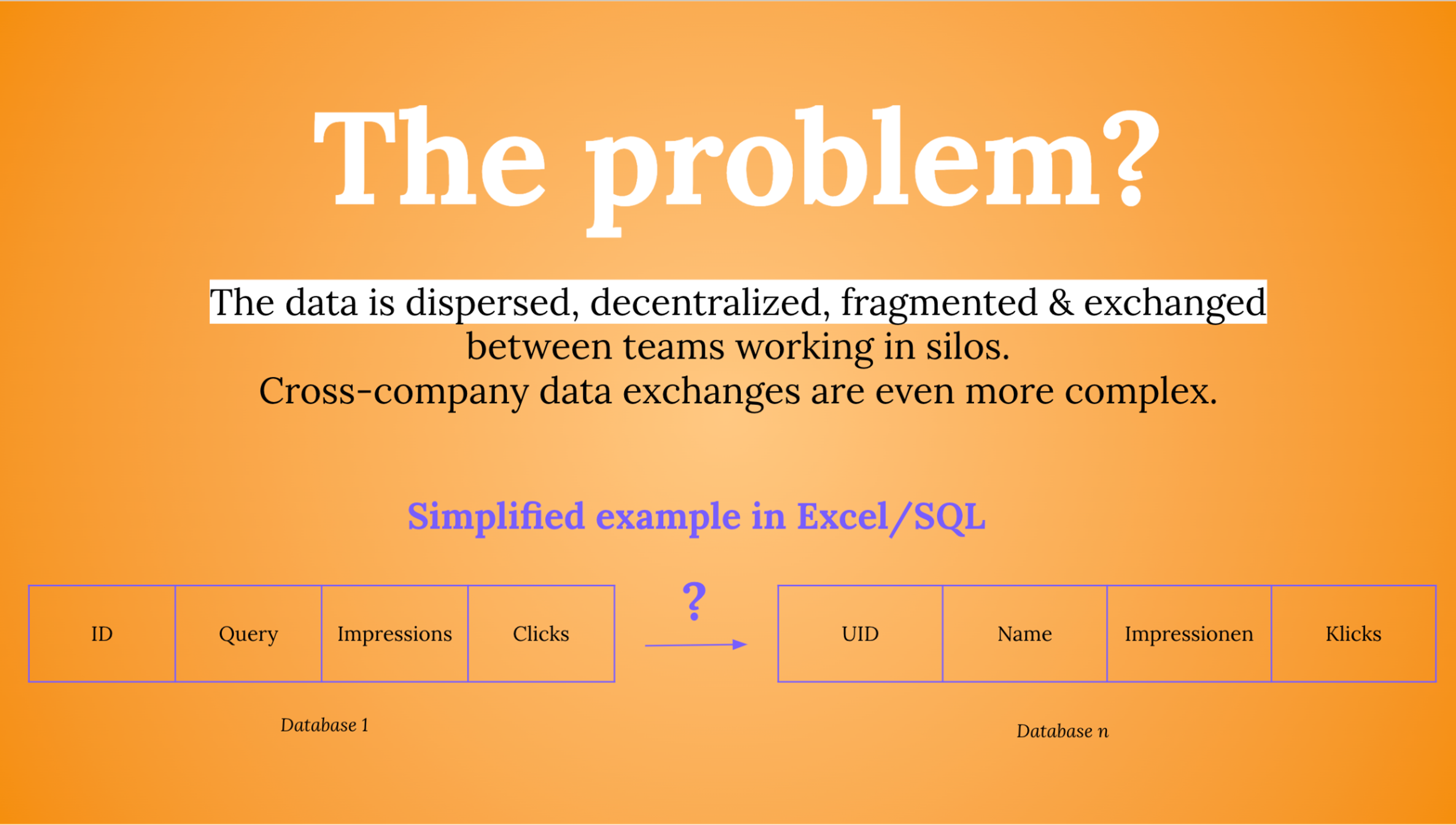
Let’s begin small and overview the advantages of a shared ontology with a sensible instance (here’s a slide taken from Emilija Gjorgjevska’s presentation at this yr’s ZagrebSEOSummit)
 Picture from Emilija Gjorgjevska’s, ZagrebSEOSummit, August 2024
Think about your colleague Valentina makes use of a Chrome extension to export information from Google Search Console (GSC) into Google Sheets. The info consists of columns like “ID,” “Question,” and “Impressions” (as proven on the left). However Valentina collaborates with Jan, who’s constructing a enterprise layer utilizing the identical GSC information. Right here’s the issue: Jan makes use of a special naming conference (“UID,” “Title,” “Impressionen,” and “Klicks”).
Now, scale this state of affairs up. Think about working with n completely different information companions, instruments, and staff members, all utilizing numerous languages. The trouble to always translate and reconcile these completely different naming conventions turns into a serious impediment to efficient information collaboration.
Vital worth will get misplaced in simply making an attempt to make all the things work collectively. That is the place an Web optimization ontology is available in. It’s a frequent language, offering a shared title for a similar idea throughout completely different instruments, companions, and languages.
By eliminating the necessity for fixed translation and reconciliation, an Web optimization ontology streamlines information collaboration and unlocks the true worth of your information.
The Genesis Of SEOntology
Within the final yr, we’ve got witnessed the proliferation of AI Brokers and the extensive adoption of Retrieval Augmented Era (RAG) in all its completely different kinds (Modular, Graph RAG, and so forth).
RAG represents an essential leap ahead in AI expertise, addressing a key limitation of traditional large language models (LLMs) by letting them entry exterior data.
Historically, LLMs are like libraries with one e book – restricted by their coaching information. RAG unlocks an enormous community of sources, permitting LLMs to offer extra complete and correct responses.
RAGs enhance factual accuracy, and context understanding, doubtlessly lowering bias. Whereas promising, RAG faces challenges in information safety, accuracy, scalability, and integration, especially in the enterprise sector.
For profitable implementation, RAG requires high-quality, structured information that may be simply accessed and scaled.
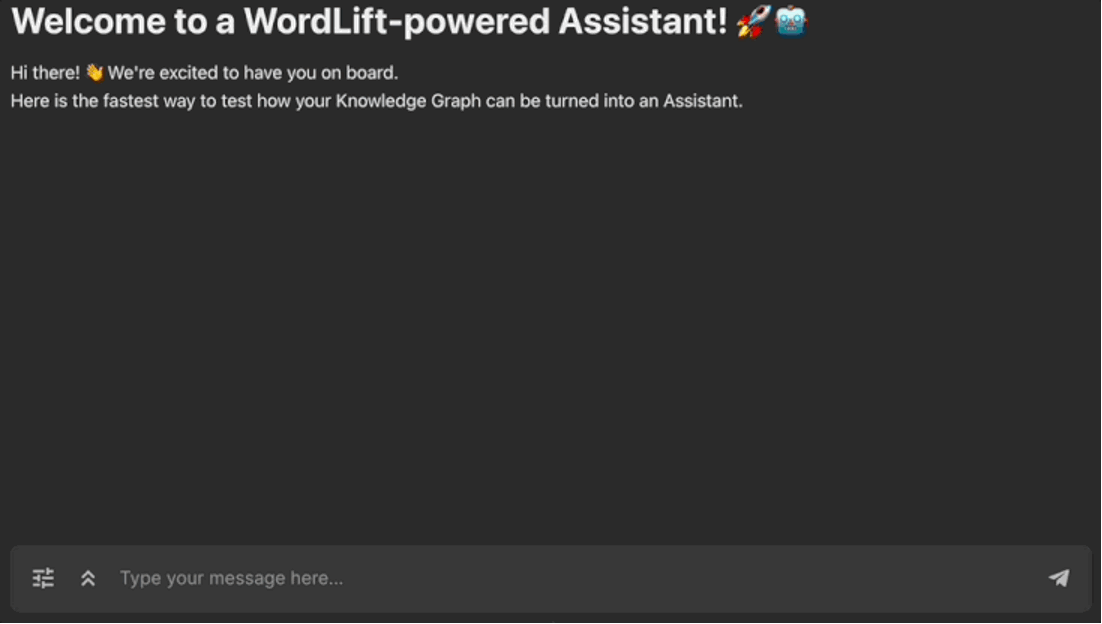
We’ve been among the many first to experiment with AI Agents and RAG powered by the Data Graph within the context of content material creation and Web optimization automation.
 Screenshot from Agent WordLift, August 2023
Data Graphs (KGs) Are Certainly Gaining Momentum In RAG Growth
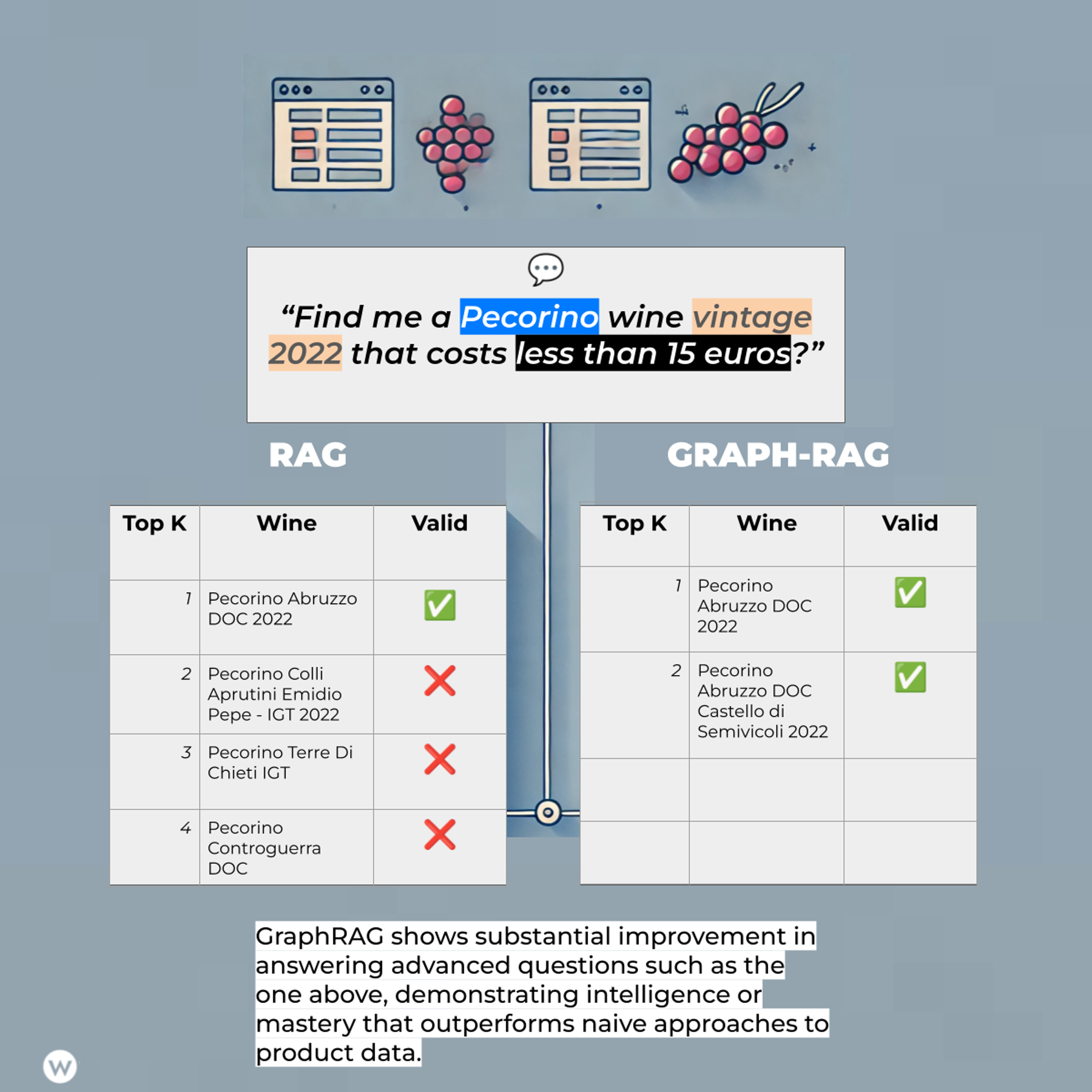
Microsoft’s GraphRAG and options like LlamaIndex display this. Baseline RAG struggles to attach data throughout disparate sources, hindering duties requiring a holistic understanding of enormous datasets.
KG-powered RAG approaches just like the one provided by LlamaIndex in conjunction with WordLift handle this by making a data graph from web site information and utilizing it alongside the LLM to enhance response accuracy, significantly for complicated questions.
 Picture from writer, August 2024
We’ve examined workflows with shoppers in numerous verticals for over a yr.
From key phrase analysis for giant editorial groups to the era of query and solutions for ecommerce web sites, from content material bucketing to drafting the define of a publication or revamping current articles, we’ve been testing completely different methods and realized a number of issues alongside the way in which:
1. RAG Is Overhyped
It’s merely one in every of many improvement patterns that obtain a objective of upper complexity. A RAG (or Graph RAG) is supposed that can assist you save time discovering a solution. It’s sensible however doesn’t clear up any advertising duties a staff should deal with every day. You could concentrate on the info and the info mannequin.
Whereas there are good RAGs and dangerous RAGs, the important thing differentiation is usually represented by the “R” a part of the equation: the Retrieval. Primarily, the retrieval differentiates a flowery demo from a real-world utility, and behind an excellent RAG, there may be at all times good information. Information, although, is not only any sort of information (or graph information).
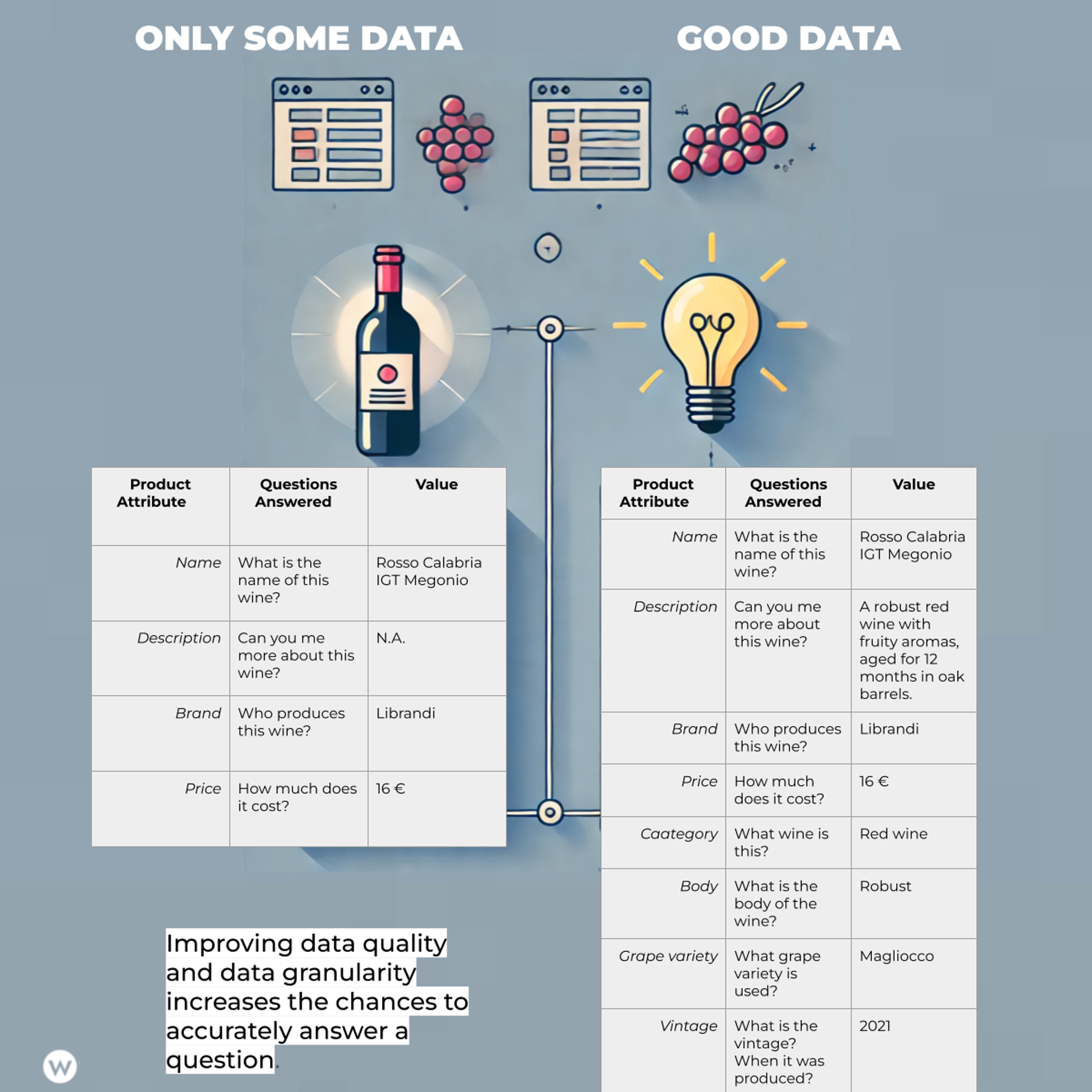
It’s constructed round a coherent information mannequin that is smart on your use case. In case you construct a search engine for wines, it’s essential get the most effective dataset and mannequin the info across the incorporates a consumer will depend on when in search of data.
So, information is essential, however the information mannequin is much more essential. If you’re constructing an AI Agent that has to do issues in your advertising ecosystem, it’s essential to mannequin the info accordingly. You need to characterize the essence of net pages and content material belongings.
 Picture from writer, August 2024
2. Not Everybody Is Nice At Prompting
Expressing a activity in written type is tough. Prompt engineering goes at full pace in the direction of automation (right here is my article on going from prompting to prompt programming for SEO) as only some consultants can write the immediate that brings us to the anticipated final result.
This poses a number of challenges for the design of the consumer expertise of autonomous brokers. Jakon Nielsen has been very vocal about the negative impact of prompting on the usability of AI applications:
“One main usability draw back is that customers have to be extremely articulate to jot down the required prose textual content for the prompts.”
Even in wealthy Western nations, statistics offered by Nielsen inform us that solely 10% of the inhabitants can totally make the most of AI!
| Easy Immediate Utilizing Chain-of-Thought (CoT) | Extra Subtle Immediate Combining Graph-of-Thought (GoT) and Chain-of-Data (CoK) |
| “Clarify step-by-step easy methods to calculate the world of a circle with a radius of 5 items.” | “Utilizing the Graph-of-Thought (GoT) and Chain-of-Data (CoK) methods, present a complete clarification of easy methods to calculate the world of a circle with a radius of 5 items. Your response ought to: Begin with a GoT diagram that visually represents the important thing ideas and their relationships, together with: Circle Radius Space Pi (π) Formulation for circle space Observe the GoT diagram with a CoK breakdown that: a) Defines every idea within the diagram b) Explains the relationships between these ideas c) Supplies the historic context for the event of the circle space method Current a step-by-step calculation course of, together with: a) Stating the method for the world of a circle b) Explaining the function of every element within the method c) Displaying the substitution of values d) Performing the calculation e) Rounding the end result to an acceptable variety of decimal locations Conclude with sensible purposes of this calculation in real-world eventualities. All through your clarification, be sure that every step logically follows the earlier one, creating a transparent chain of reasoning from primary ideas to the ultimate end result.” This improved immediate incorporates GoT by requesting a visible illustration of the ideas and their relationships. It additionally employs CoK by asking for definitions, historic context, and connections between concepts. The step-by-step breakdown and real-world purposes additional improve the depth and practicality of the reason.” |
3. You Shall Construct Workflows To Information The Person
The lesson realized is that we should construct detailed customary working procedures (SOP) and written protocols that define the steps and processes to make sure consistency, high quality, and effectivity in executing specific optimization duties.
We will see empirical proof of the rise of immediate libraries just like the one offered to users of Anthropic models or the unimaginable success of initiatives like AIPRM.
In actuality, we realized that what creates enterprise worth is a sequence of ci steps that assist the consumer translate the context he/she is navigating in right into a constant activity definition.
We will begin to envision advertising duties like conducting key phrase analysis as a Customary Working Process that may information the consumer throughout a number of steps (here is how we intend the SOP for key phrase discovery utilizing Agent WordLift)
4. The Nice Shift To Simply-in-Time UX
In conventional UX design, data is pre-determined and could be organized in hierarchies, taxonomies, and pre-defined UI patterns. As AI turns into the interface to the complicated world of data, we’re witnessing a paradigm shift.
UI topologies are likely to disappear, and the interplay between people and AI stays predominantly dialogic. Simply-in-time assisted workflows will help the consumer contextualize and enhance a workflow.
- You could assume by way of enterprise worth creation, concentrate on the consumer’s interactive journey, and facilitate the interplay by making a UX on the fly. Taxonomies stay a strategic asset, however they function behind the scenes because the consumer is teleported from one activity to a different, as not too long ago brilliantly described by Yannis Paniaras from Microsoft.
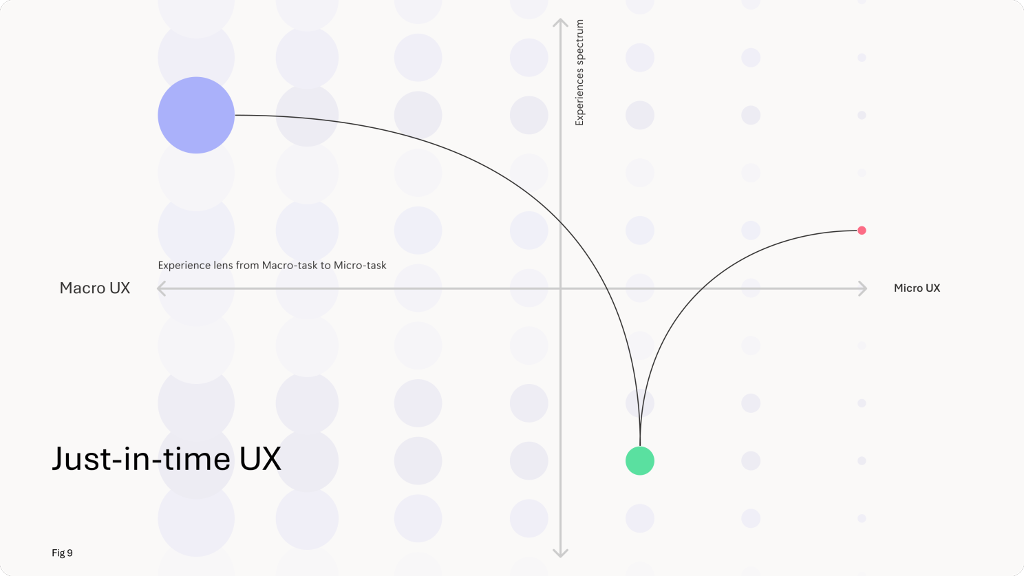 Picture from “The Shift to Simply-In-Time UX: How AI is Reshaping Person Experiences” by Yannis Paniaras, August 2024
5. From Brokers To RAG (And GraphRAG) To Reporting
As a result of the consumer wants a enterprise influence and RAG is barely a part of the answer, the main focus rapidly shifts from extra generic questions and answering consumer patterns to superior multi-step workflows.
The largest situation, although, is what final result the consumer wants. If we enhance the complexity to seize the very best enterprise objectives, it isn’t sufficient to, let’s say, “question your information” or “chat along with your web site.”
A consumer needs a report, for instance, of what’s the thematic consistency of content material throughout the total web site (this can be a idea that we not too long ago found as SiteRadus in Google’s large information leak), the overview of the seasonal tendencies throughout lots of of paid campaigns, or the final word overview of the optimization alternatives associated to the optimization of Google Service provider Feed.
You should perceive how the enterprise operates and what deliverables you’ll pay for. What concrete actions may enhance the enterprise? What questions have to be answered?
That is the beginning of making an incredible AI-assisted reporting software.
How Can A Data Graph (KG) Be Coupled With An Ontology For AI Alignment, Lengthy-term Reminiscence, And Content material Validation?
The three guiding ideas behind SEOntology:
- Making Web optimization information interoperable to facilitate the creation of information graphs whereas lowering unneeded crawls and vendor locked-in;
- Infusing Web optimization know-how into AI brokers utilizing a domain-specific language.
- Collaboratively sharing data and ways to enhance findability and forestall misuse of Generative AI.
If you cope with at the very least two information sources in your Web optimization automation activity, you’ll already see the benefit of utilizing SEOntology.
SEOntology As “The USB-C Of Web optimization/Crawling Information”
Standardizing information about content material belongings, merchandise, consumer search habits, and Web optimization insights is strategic. The objective is to have a “shared illustration” of the Internet as a communication channel.
Let’s take a step backward. How does a Search Engine characterize an online web page? That is our start line right here. Can we standardize how a crawler would characterize information extracted from an internet site? What are the benefits of adopting requirements?
Sensible Use Circumstances
Integration With Botify And Dynamic Inside Linking
Over the previous few months, we’ve been working intently with the Botify staff to create one thing thrilling: a Data Graph powered by Botify’s crawl information and enhanced by SEOntology. This collaboration is opening up new potentialities for Web optimization automation and optimization.
Leveraging Current Information With SEOntology
Right here’s the cool half: In case you’re already utilizing Botify, we will faucet into that goldmine of information you’ve collected. No want for added crawls or additional work in your half. We use the Botify Question Language (BQL) to extract and rework the wanted information utilizing SEOntology.
Consider SEOntology as a common translator for Web optimization information. It takes the complicated data from Botify and turns it right into a format that’s not simply machine-readable however machine-understandable. This permits us to create a wealthy, interconnected Data Graph stuffed with useful Web optimization insights.
What This Means for You
As soon as we’ve got this Data Graph, we will do some fairly wonderful issues:
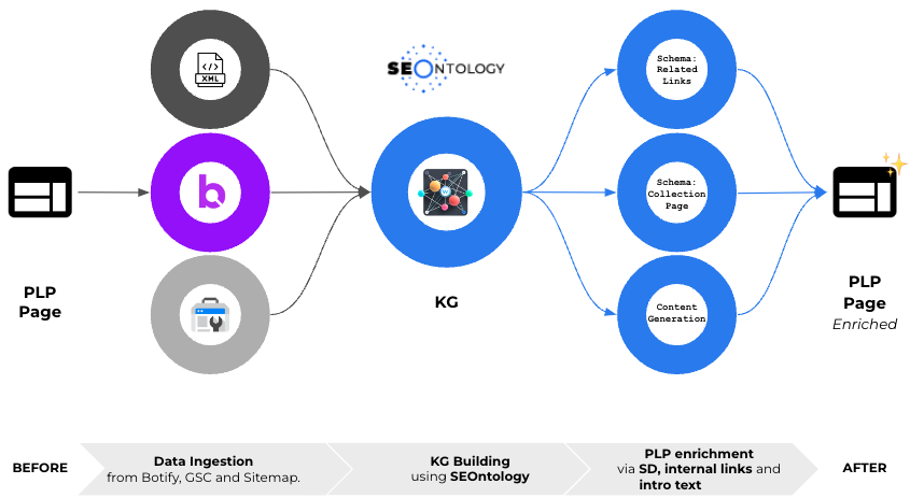
- Automated Structured Information: We will robotically generate structured information markup on your product itemizing pages (PLPs). This helps serps higher perceive your content material, doubtlessly enhancing your visibility in search outcomes.
- Dynamic Inside Linking: That is the place issues get actually attention-grabbing. We use the info within the Data Graph to create sensible, dynamic inner hyperlinks throughout your web site. Let me break down how this works and why it’s so highly effective.
Within the diagram under, we will additionally see how information from Botify could be blended with information from Google Search Console.
Whereas in most implementations, Botify already imports this information into its crawl initiatives, when this isn’t the case, we will set off a brand new API request and import clicks, impressions, and positions from GSC into the graph.
Collaboration With Advertools For Information Interoperability
Equally, we collaborated with the sensible Elias Dabbas, creator of Advertools — a favourite Python library amongst entrepreneurs – to automate a variety of selling duties.
Our joint efforts purpose to reinforce information interoperability, permitting for seamless integration and information trade throughout completely different platforms and instruments.
Within the first Notebook, obtainable within the SEOntology GitHub repository, Elias showcases how we will effortlessly assemble attributes for the WebPage class, together with title, meta description, photos, and hyperlinks. This basis allows us to simply mannequin complicated components, akin to inner linking methods. See right here the construction:
-
- anchorTextContent
- NoFollow
- Hyperlink
We will additionally add a flag if the web page is already utilizing schema markup:
Formalizing What We Discovered From The Evaluation Of The Leaked Google Search Paperwork
Whereas we need to be extraordinarily acutely aware in deriving ways or small schemes from Google’s large leak, and we’re properly conscious that Google will rapidly forestall any potential misuse of such data, there’s a nice degree of data that, based mostly on what we realized, can be utilized to enhance how we characterize net content material and arrange advertising information.
Regardless of these constraints, the leak provides useful insights into enhancing net content material illustration and advertising information group. To democratize entry to those insights, I’ve developed a Google Leak Reporting tool designed to make this data available to Web optimization execs and digital entrepreneurs.
As an illustration, understanding Google’s classification system and its segmentation of internet sites into numerous taxonomies has been significantly enlightening. These taxonomies – akin to ‘verticals4’, ‘geo’, and ‘products_services’ – play a vital function in search rating and relevance, every with distinctive attributes that affect how web sites and content material are perceived and ranked in search outcomes.
By leveraging SEOntology, we will undertake a few of these attributes to reinforce web site illustration.
Now, pause for a second and picture reworking the complicated Web optimization information you handle every day by instruments like Moz, Ahrefs, Screaming Frog, Semrush, and plenty of others into an interactive graph. Now, envision an Autonomous AI Agent, akin to Agent WordLift, at your facet.
This agent employs neuro-symbolic AI, a cutting-edge strategy that mixes neural studying capabilities with symbolic reasoning, to automate Web optimization duties like creating and updating inner hyperlinks. This streamlines your workflow and introduces a degree of precision and effectivity beforehand unattainable.
SEOntology serves because the spine for this imaginative and prescient, offering a structured framework that permits the seamless trade and reuse of Web optimization information throughout completely different platforms and instruments. By standardizing how Web optimization information is represented and interconnected, SEOntology ensures that useful insights derived from one software could be simply utilized and leveraged by others. As an illustration, information on key phrase efficiency from SEMrush may inform content material optimization methods in WordLift, all inside a unified, interoperable setting. This not solely maximizes the utility of current information but additionally accelerates the automation and optimization processes which are essential for efficient advertising.
Infusing Web optimization Know-How Into AI Brokers
As we develop a brand new agentic strategy to Web optimization and digital advertising, SEOntology serves as our domain-specific language (DSL) for encoding Web optimization abilities into AI brokers. Let’s have a look at a sensible instance of how this works.
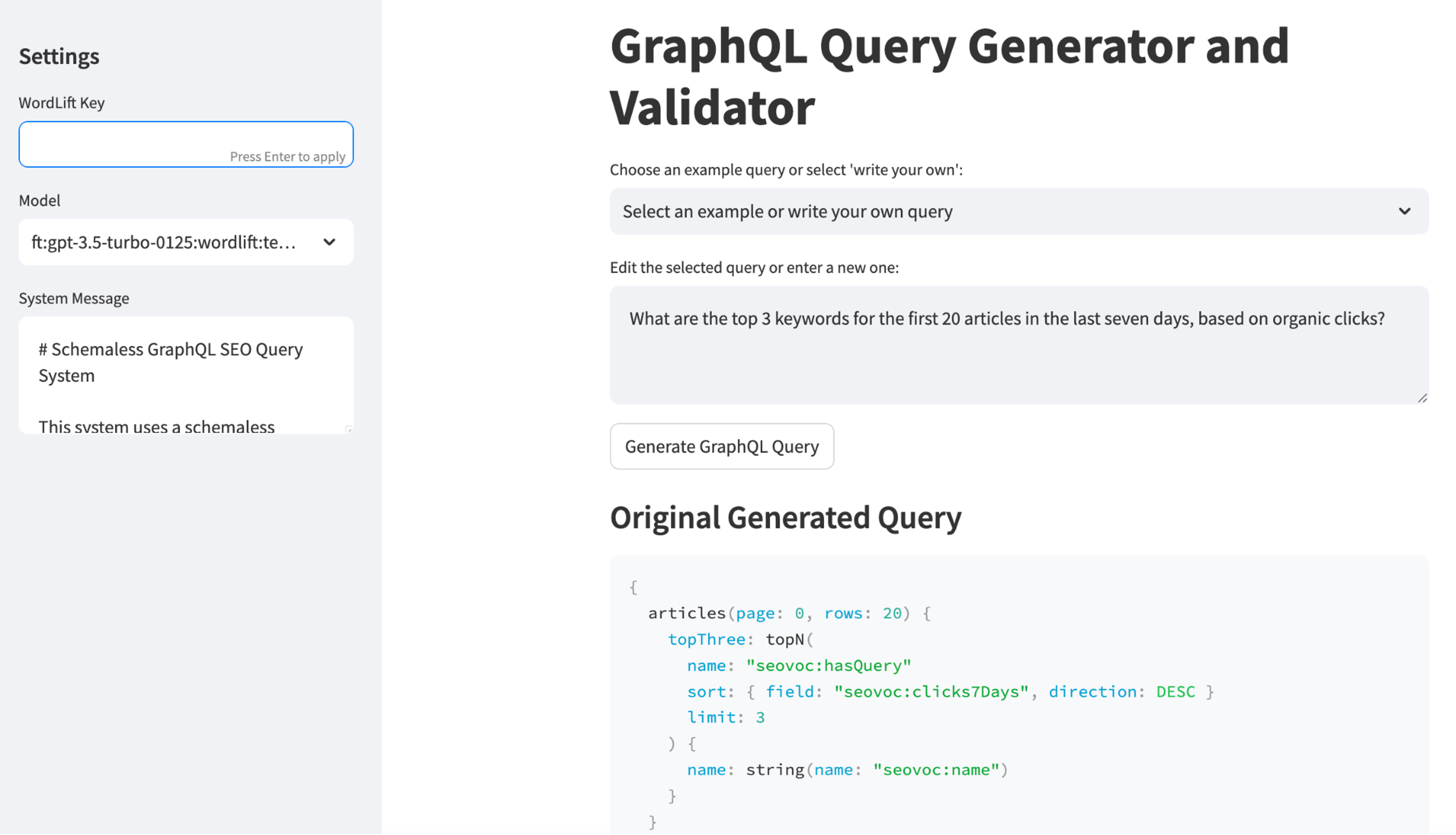 Screenshot from WordLift, August 2024
We’ve developed a system that makes AI brokers conscious of an internet site’s natural search efficiency, enabling a brand new sort of interplay between Web optimization professionals and AI. Right here’s how the prototype works:
System Parts
- Data Graph: Shops Google Search Console (GSC) information, encoded with SEOntology.
- LLM: Interprets pure language queries into GraphQL and analyzes information.
- AI Agent: Supplies insights based mostly on the analyzed information.
Human-Agent Interplay
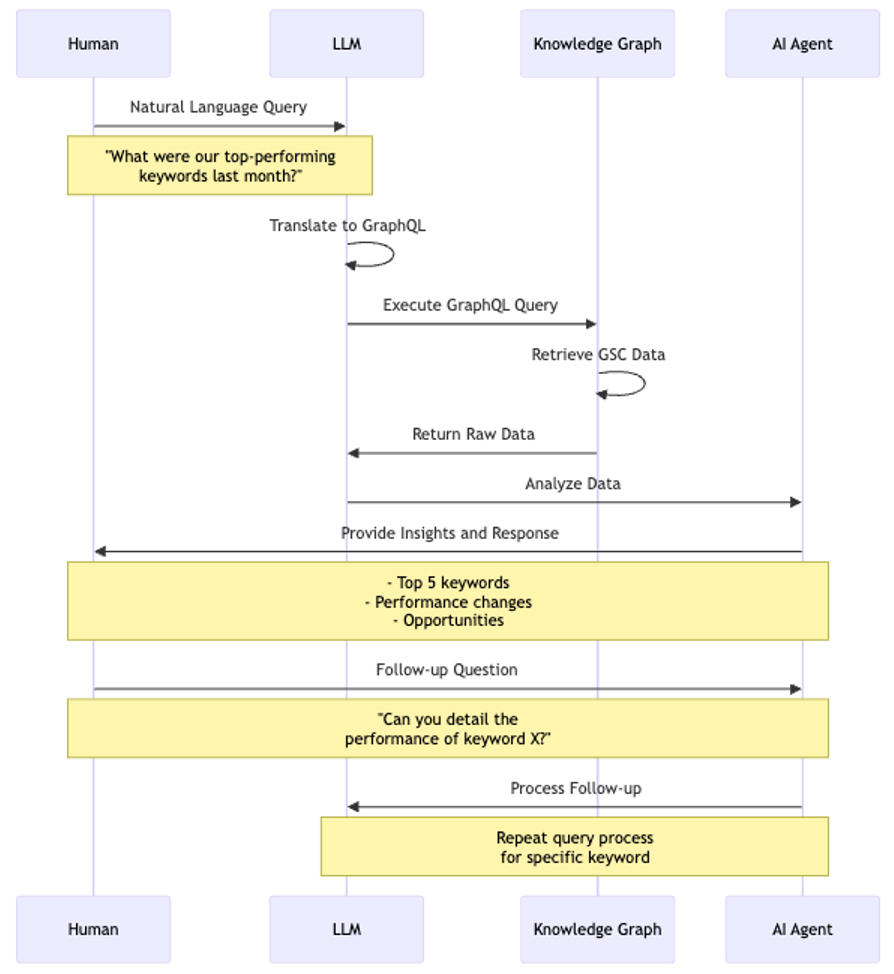 Picture from writer, August 2024
The diagram illustrates the circulate of a typical interplay. Right here’s what makes this strategy highly effective:
- Pure Language Interface: Web optimization professionals can ask questions in plain language with out setting up complicated queries.
- Contextual Understanding: The LLM understands Web optimization ideas, permitting for extra nuanced queries and responses.
- Insightful Evaluation: The AI agent doesn’t simply retrieve information; it supplies actionable insights, akin to:
- Figuring out top-performing key phrases.
- Highlighting vital efficiency modifications.
- Suggesting optimization alternatives.
- Interactive Exploration: Customers can ask follow-up questions, enabling a dynamic exploration of Web optimization efficiency.
By encoding Web optimization data by SEOntology and integrating efficiency information, we’re creating AI brokers that may present context-aware, nuanced help in Web optimization duties. This strategy bridges the hole between uncooked information and actionable insights, making superior Web optimization evaluation extra accessible to professionals in any respect ranges.
This instance illustrates how an ontology like SEOntology can empower us to construct agentic Web optimization instruments that automate complicated duties whereas sustaining human oversight and guaranteeing high quality outcomes. It’s a glimpse into the way forward for Web optimization, the place AI augments human experience somewhat than changing it.
Human-In-The-Loop (HTIL) And Collaborative Data Sharing
Let’s be crystal clear: Whereas AI is revolutionizing Web optimization and Search, people are the beating coronary heart of our {industry}. As we dive deeper into the world of SEOntology and AI-assisted workflows, it’s essential to know that Human-in-the-Loop (HITL) isn’t only a fancy add-on—it’s the inspiration of all the things we’re constructing.
The essence of making SEOntology is to switch our collective Web optimization experience to machines whereas guaranteeing we, as people, stay firmly within the driver’s seat. It’s not about handing over the keys to AI; it’s about educating it to be the final word co-pilot in our Web optimization journey.
Human-Led AI: The Irreplaceable Human Ingredient
SEOntology is greater than a technical framework – it’s a catalyst for collaborative data sharing that emphasizes human potential in Web optimization. Our dedication extends past code and algorithms to nurturing abilities and increasing the capabilities of new-gen entrepreneurs and Web optimization execs.
Why? As a result of AI’s true energy in Web optimization is unlocked by human perception, numerous views, and real-world expertise. After years of working with AI workflows, I’ve realized that agentive Web optimization is basically human-centric. We’re not changing experience; we’re amplifying it.
We ship extra environment friendly and reliable outcomes by mixing cutting-edge tech with human creativity, instinct, and moral judgment. This strategy builds belief with shoppers inside our {industry} and throughout the online.
Right here’s the place people stay irreplaceable:
- Understanding Enterprise Wants: AI can crunch numbers however can’t exchange the nuanced understanding of enterprise targets that seasoned Web optimization professionals deliver. We’d like consultants who can translate consumer objectives into actionable Web optimization methods.
- Figuring out Shopper Constraints: Each enterprise is exclusive, with its limitations and alternatives. It takes human perception to navigate these constraints and develop tailor-made Web optimization approaches that work inside real-world parameters.
- Creating Reducing-Edge Algorithms: The algorithms powering our AI instruments don’t materialize out of skinny air. We’d like sensible minds to develop state-of-the-art algorithms, be taught from human enter, and frequently enhance.
- Engineering Sturdy Methods: Behind each smooth-running AI software is a staff of software program engineers who guarantee our methods are quick, safe, and dependable. This human experience retains our AI assistants operating like well-oiled machines.
- Ardour for a Higher Internet: On the coronary heart of Web optimization is a dedication to creating the online a greater place. We’d like individuals who share Tim Berners’s—Lee’s imaginative and prescient—people who find themselves captivated with growing the online of information and enhancing the digital ecosystem for everybody.
- Group Alignment and Resilience: We have to unite to investigate the habits of search giants and develop resilient methods. It’s about fixing our issues innovatively as people and as a collective power. That is what I at all times cherished concerning the Web optimization {industry}!
Extending The Attain Of SEOntology
As we proceed to develop SEOntology, we’re not working in isolation. As an alternative, we’re constructing upon and increasing current requirements, significantly Schema.org, and following the profitable mannequin of the GS1 Internet Vocabulary.
SEOntology As An Extension Of Schema.org
Schema.org has develop into the de facto customary for structured information on the net, offering a shared vocabulary that site owners can use to markup their pages.
Nevertheless, whereas Schema.org covers a broad vary of ideas, it doesn’t delve deeply into Web optimization-specific components. That is the place SEOntology is available in.
An extension of Schema.org, like SEOntology, is actually a complementary vocabulary that provides new varieties, properties, and relationships to the core Schema.org vocabulary.
This permits us to take care of compatibility with current Schema.org implementations whereas introducing Web optimization-specific ideas not lined within the core vocabulary.
Studying From GS1 Internet Vocabulary
The GS1 Internet Vocabulary provides an awesome mannequin for making a profitable extension that interacts seamlessly with Schema.org. GS1, a worldwide group that develops and maintains provide chain requirements, created its Internet Vocabulary to increase Schema.org for e-commerce and product data use instances.
The GS1 Internet Vocabulary demonstrates, even not too long ago, how industry-specific extensions can affect and work together with schema markup:
- Actual-world influence: The https://schema.org/Certification property, now formally embraced by Google, originated from GS1’s https://www.gs1.org/voc/CertificationDetails. This showcases how extensions can drive the evolution of Schema.org and search engine capabilities.
We need to comply with an analogous strategy to increase Schema.org and develop into the usual vocabulary for Web optimization-related purposes, doubtlessly influencing future search engine capabilities, AI-driven workflows, and Web optimization practices.
Very like GS1 outlined their namespace (gs1:) whereas referencing schema phrases, we’ve got outlined our namespace (seovoc:) and are integrating the lessons throughout the Schema.org hierarchy when potential.
The Future Of SEOntology
SEOntology is greater than only a theoretical framework; it’s a sensible software designed to empower Web optimization professionals and gear makers in an more and more AI-driven ecosystem.
Right here’s how one can have interaction with and profit from SEOntology.
In case you’re growing Web optimization instruments:
- Information Interoperability: Implement SEOntology to export and import information in a standardized format. This ensures your instruments can simply work together with different SEOntology-compliant methods.
- AI-Prepared Information: By structuring your information in response to SEOntology, you’re making it extra accessible for AI-driven automations and analyses.
In case you’re an Web optimization skilled:
- Contribute to Growth: Identical to with Schema.org, you possibly can contribute to SEOntology’s evolution. Go to its GitHub repository to:
- Increase points for brand spanking new ideas or properties you assume must be included.
- Suggest modifications to current definitions.
- Take part in discussions concerning the future path of SEOntology.
- Implement in Your Work: Begin utilizing SEOntology ideas in your structured information.
In Open Supply We Belief
SEOntology is an open-source effort, following within the footsteps of profitable initiatives like Schema.org and different shared linked vocabularies.
All discussions and choices shall be public, guaranteeing the neighborhood has a say in SEOntology’s path. As we achieve traction, we’ll set up a committee to steer its improvement and share common updates.
Conclusion And Future Work
The way forward for advertising is human-led, not AI-replaced. SEOntology isn’t simply one other buzzword – it’s a step in the direction of this future. Web optimization is strategic for the event of agentive advertising practices.
Web optimization is not about rankings; it’s about creating clever, adaptive content material and fruitful dialogues with our stakeholders throughout numerous channels. Standardizing Web optimization information and practices is strategic to construct a sustainable future and to invest in responsible AI.
Are you prepared to hitch this revolution?
There are three guiding ideas behind the work of SEOntology that we have to clarify to the reader:
- As AI wants semantic information, we have to make Web optimization information interoperable, facilitating the creation of information graphs for everybody. SEOntology is the USB-C of Web optimization/crawling information. Standardizing information about content material belongings and merchandise and the way folks discover content material, merchandise, and knowledge usually is essential. That is the primary goal. Right here, we’ve got two sensible use instances. We’ve a connector for WordLift that will get crawl information from the Botify crawler and helps you jump-start a KG that makes use of SEOntology as a knowledge mannequin. We’re additionally working with Advertools, an open-source crawler and Web optimization software, to make information interoperable with SEOntology;
- As we progress with the event of a brand new agentic method of doing Web optimization and digital advertising, we need to infuse the know-how of Web optimization utilizing SEOntology, a domain-specific language to infuse the Web optimization mindset to Web optimization brokers (or multi-agent methods like Agent WordLift). On this context, the ability required to create dynamic inner hyperlinks is encoded as nodes in a data graph, and alternatives develop into triggers to activate workflows.
- We anticipate to work with human-in-the-loop HITL, that means that the ontology will develop into a solution to collaboratively share data and ways that assist enhance findability and forestall the misuse of Generative AI that’s polluting the Internet right this moment.
Venture Overview
This work on SEOntology is the product of collaboration. I prolong my honest because of the WordLift staff, particularly CTO David Riccitelli. I additionally recognize our shoppers for his or her dedication to innovation in Web optimization by data graphs. Particular because of Milos Jovanovik and Emilia Gjorgjevska for his or her crucial experience. Lastly, I’m grateful to the Web optimization neighborhood and the SEJ editorial staff for his or her help in sharing this work.
Extra sources:
Featured Picture: tech_BG/Shutterstock
