



Google’s Core Net Vitals have been a ranking signal since 2021 when Google launched three metrics to measure the standard of consumer experiences on an internet site.
Actual consumer monitoring information can let you know how properly you do on Core Net Vitals and what you are able to do to enhance them. This is applicable particularly to the brand new Interaction to Next Paint (INP) metric that turns into one of many Core Net Vitals on March 12, 2024.
What’s the distinction between lab information and actual consumer information?
When measuring net efficiency, we will take a look at both lab information (additionally referred to as artificial information) or actual consumer information (additionally referred to as area information).
Lab information is collected in a managed check surroundings. It tells you how briskly your web site masses from a given check location, with a given community connection and a particular check gadget. That makes it very constant between exams, and the reporting might be very detailed as testing instruments have full management over the check surroundings. Lighthouse is an instance of an artificial testing software.
In distinction, actual consumer information is collected from guests once they go to your web site. Every customer can have a special expertise relying on the place they’re situated, how briskly their web connection is and how much gadget they’re utilizing. So when a metric we have to take a look at a statistical common just like the 75th percentile that’s generally used when reporting Core Net Vitals information.
You’ll usually see that the metric values don’t match between lab and field data. Finally what you care about is actual consumer expertise, however artificial information can present much more depth that will help you perceive and enhance your web page pace.

Why is actual consumer information necessary to enhance your Core Net Vitals?
Running a lab-based page speed test is nice to research the preliminary load pace of your web site. However different metrics rely upon how customers work together with the web page as soon as it’s been opened.
This is applicable particularly to the brand new Interplay to Subsequent Paint metric. Your INP rating is dependent upon what web page parts customers are interacting with, and at what level throughout the web page load course of these interactions occur.
Whereas Cumulative Layout Shift (CLS) could happen throughout the preliminary web page load, it usually occurs in response to a consumer interplay or when scrolling down a web page. Should you solely accumulate information in an artificial surroundings, you’ll miss these format shifts that occur afterward within the lifetime of an internet site go to.
Find out how to accumulate actual consumer Core Net Vitals information
An actual consumer monitoring (RUM) answer like DebugBear may also help you accumulate Core Net Vitals information in your guests. You arrange an analytics snippet in your web site and this information is then aggregated and proven in a Core Net Vitals dashboard.
You possibly can see whether or not any of your most visited pages are sluggish and the way consumer expertise varies primarily based on the situation of your guests.

Find out how to determine what pages to optimize
To start with, examine if any of your hottest pages are failing the Core Net Vitals evaluation. It’s also possible to use Google Search Console to establish pages with poor consumer expertise in your web site.
When you’ve recognized a web page you may dive extra deeply into analyzing your RUM information and discovering methods to enhance.
Enhance Largest Contentful Paint with actual consumer information
Actual consumer monitoring information for a web page may also help you perceive the influence varied efficiency optimizations would have.
LCP Optimization Potential evaluation exhibits what you should optimize to enhance LCP:
- Time to First Byte (TTFB): This element appears at how rapidly the server responds to the HTML request.
- First Contentful Paint (FCP): This tells you whether or not there are render-blocking resources that forestall web page content material from showing.
- LCP: This exhibits how lengthy it takes for the LCP factor to point out up after the web page first renders

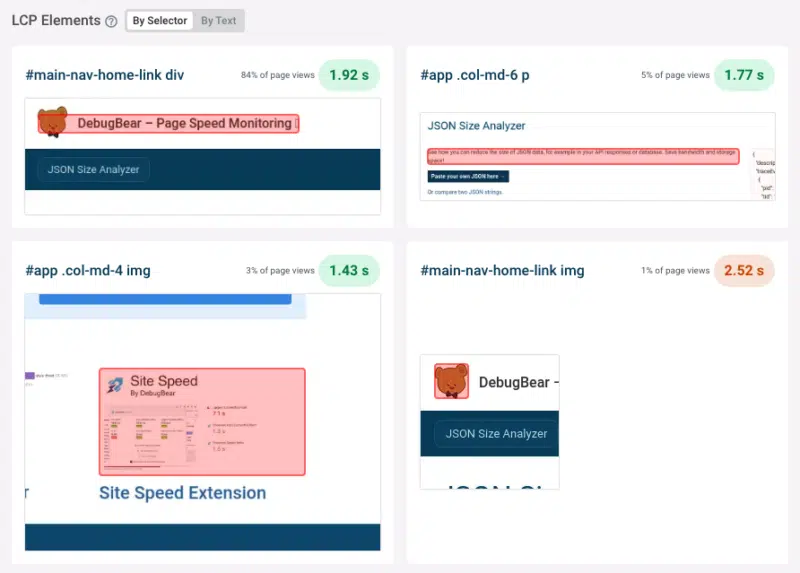
See what web page parts are answerable for the Largest Contentful Paint
Completely different guests viewing the identical web page will see completely different content material when the web page first masses. The most important content material factor varies between desktop and cellular customers and between logged-in and logged-out customers.
Analyzing what web page parts most frequently find yourself because the LCP factor helps you perceive what optimizations will assist the biggest variety of customers. It additionally allows you to see if there are some LCP parts that end in significantly poor LCP scores.
Scale back render-blocking assets
If the First Contentful Paint element contributes a major period of time to your LCP rating you should see what might be executed to make your web site render earlier.
Instruments like DebugBear and others let you know what the final render-blocking request is for every web page view. Should you load this useful resource extra rapidly then the First Contentful Paint will occur sooner.

Optimize LCP Photos
The LCP Ingredient breakdown tells us what sort of factor is answerable for the LCP for various customers. Right here the evaluation exhibits us {that a} background picture is answerable for the Largest Contentful Paint 96% of the time. Meaning we should always concentrate on loading that picture extra rapidly.
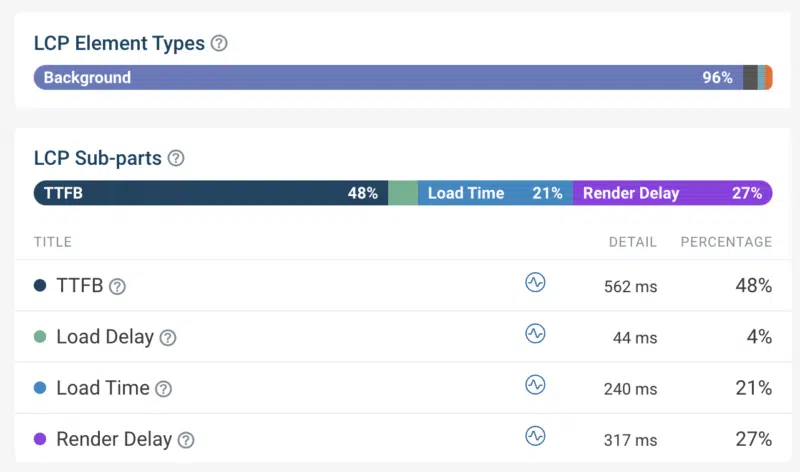
The LCP sub-parts breakdown helps us optimize picture loading efficiency by parts that comply with the TTFB:
- Load Delay: How rapidly after loading the HTML doc does the browser begin loading the picture?
- Load Time: How lengthy does it take to obtain the picture?
- Render Delay: Does the browser present the picture instantly after loading it or is there a delay?
On this case we will see that we have to optimize Load Time, for instance by lowering obtain dimension with a extra modern image format. The picture additionally usually finishes loading earlier than the First Contentful Paint, which suggests it stays hidden for a number of hundred milliseconds.
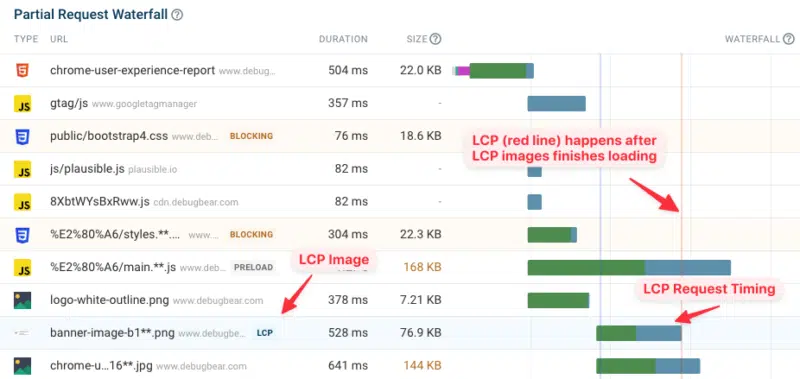
a particular web page view and investigating the request waterfall visualization may also help you higher perceive in what order completely different assets are loaded and the way lengthy a given request takes.
For instance, right here we will see what request masses the LCP picture, when that request begins, and the way quickly after the request the LCP is recorded. Right here we will see that the LCP (indicated by the purple line on the correct) occurs proper after the LCP picture is loaded, which signifies that there is no such thing as a Render Delay for this web page view.
Enhance Interplay to Subsequent Paint with actual consumer information
The INP rating of your web site drastically is dependent upon what web page parts customers are interacting with. Clicking someplace on a paragraph often doesn’t set off any code to run, and people interactions will likely be quick. A menu toggle or button that generates a brand new UI element and shows it can take much more time.
With actual consumer information you may see what parts customers are interacting with most frequently, and which of those interactions are sluggish.

Figuring out code that’s inflicting sluggish interactions
It’s also possible to see what scripts are answerable for sluggish interactions. JavaScript information could also be a part of your individual web site code or a part of a third-party service like, whether or not that’s a chat widget or e-newsletter popup.
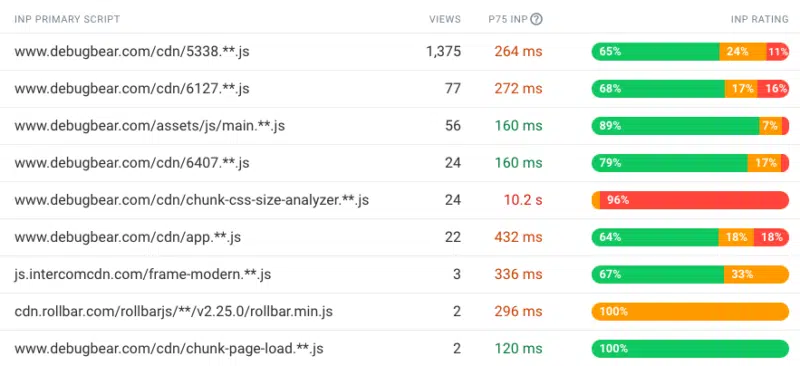
That is potential because of the brand new Long Animation Frames API that will likely be included in Chrome from mid-March 2023. This browser performance studies what code is inflicting rendering delays on a web page.
Once you take a look at an individual user experience you may see what factor the consumer interacted with and what code ran at that time, inflicting poor INP.
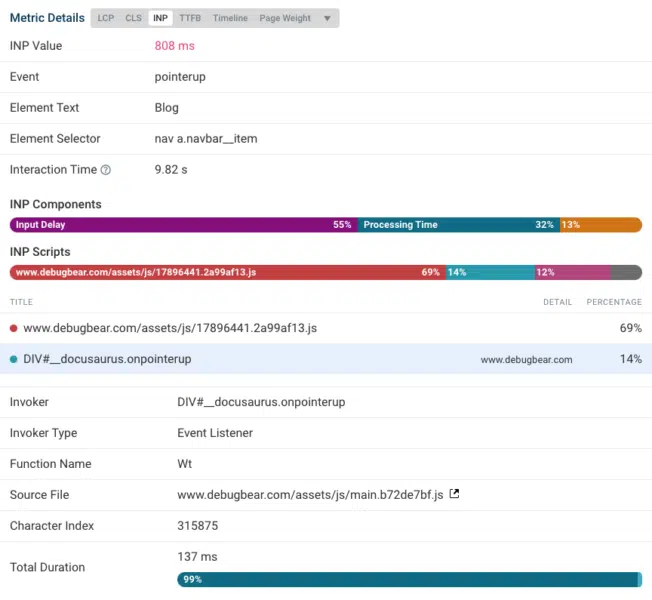
When you’ve recognized a particular script file you may then examine whether or not that script is important and if there are methods to make it run sooner.
When do sluggish interactions occur on the web page?
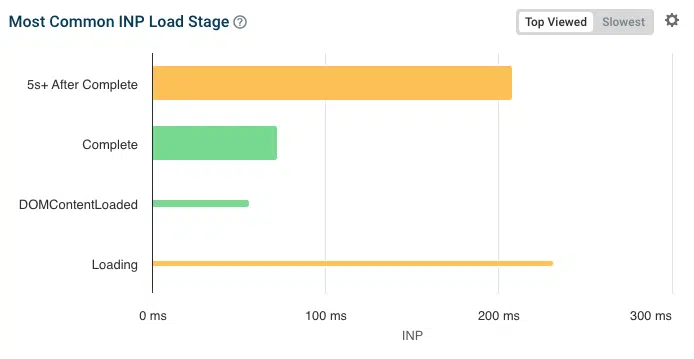
One other issue that impacts INP is the web page loading stage when the interplay occurs. Throughout the very early loading levels INP is usually excessive, as many elements of the web page are initialized which requires quite a lot of CPU processing.
If that’s the case, you may contemplate alternative ways to optimize the preliminary web page load logic and if extra room might be left for dealing with consumer interactions throughout this time.
The width of the bars on this chart signifies what number of customers encounter poor INP at every loading stage. So, whereas the early “Loading” stage causes poor INP, not that many customers are literally impacted right here.
Enhance Cumulative Structure Shift with actual consumer information
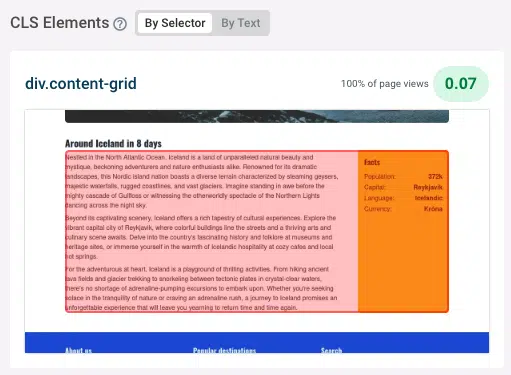
Since format shifts usually happen following a consumer interplay, actual consumer information makes it straightforward to establish shifts that you may’t detect in a lab-based check.
You possibly can see what parts shift round and what consumer interplay led as much as the format shift. For instance, a picture that seems in response to a button click on could push down different content material on the web page when the picture has completed downloading.
What’s the distinction between actual consumer monitoring (RUM) and Google CrUX information?
You should use Google’s Chrome User Experience Report (CrUX) to acquire actual consumer Core Net Vitals information to your web site, with out having to do any setup work.
Nevertheless, actual consumer monitoring addresses a number of limitations of the CrUX information:
- Regressions and enhancements present up immediately with RUM information, whereas CrUX information is aggregated over a 28-day interval.
- CrUX information is simply obtainable for high-traffic pages, whereas RUM information is accessible for any web page in your web site {that a} customer views.
- The CrUX information solely gives metric values and no debug information. You possibly can see the place your web site is struggling on the Core Net Vitals however received’t know what to do about it.
Actual consumer monitoring exhibits you the way customers are experiencing your web site and what influence it has on their conduct.

Get began with actual consumer Core Net Vitals monitoring
Seeking to enhance your net vitals, rank increased in Google, and ship a greater consumer expertise? DebugBear provides a 14-day free trial – enroll now to get the info you should optimize your web site!
