


Within the early days of digital promoting, it was fairly simple. Put in some key phrases, set budgets and monitor your clicks and click-through fee.
As advert platforms advanced to measure precise conversions, we improved our PPC adverts to raised obtain our enterprise targets.
In recent times, advert platforms have advanced much more, introducing good bidding choices that enable advertisers to manage bidding to generate probably the most conversions, highest conversion worth or lowest price per conversion.
Nevertheless, when using these bid methods, your advert efficiency can solely be as efficient in case your knowledge is appropriate.
You’ll have heard the time period GIGO – rubbish in, rubbish out. In knowledge evaluation, if we put unhealthy knowledge into the system, no matter its development, the information we get out of that system won’t be correct.
How correct is the information we’re feeding again into these advert programs?
Take the goal ROAS (return on advert spend) for instance. Suppose the income knowledge we feed again into the advert platform is inaccurate. In that case, our ROAS calculation will probably be incorrect and should falsely inflate or deflate the ROAS, resulting in probably increased prices for a marketing campaign.
Customers create knowledge inaccuracy
Regardless of your group’s greatest efforts, it’s most likely a secure guess that workers created knowledge inaccuracies.
From incorrect vacation spot URL tagging to lacking monitoring tags on key web site pages to making use of the mistaken conversion actions in campaigns, inevitably, your group has some knowledge inaccuracy.
Right here’s an instance I just lately discovered for a brand new Google Advertisements shopper. On this state of affairs, the shopper is utilizing each the Google pixel and the GA4 buy occasion to trace buy conversions in Google Advertisements.
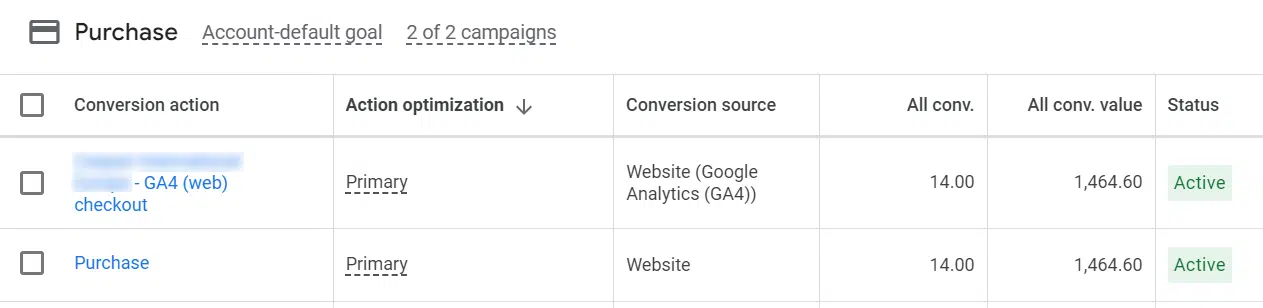
The 2 buy occasions (pixel-driven and GA4 event-driven) are each being counted as a purchase order conversion in Google Advertisements, and their mixed conversion worth would rely as the overall buy conversion worth.
Which means though the precise buy conversion whole is 14, it might be counted as 28, and the conversion worth, which must be $1,464.60, can be doubled to $2,929.20.
Let’s evaluate how these inaccuracies have an effect on marketing campaign efficiency.
For a marketing campaign that makes use of a bid technique of goal CPA, the marketing campaign would use the 28 buy conversions as the overall as an alternative of the particular 14 buy conversions.
If we set our goal CPA at $10/conversion, the marketing campaign then believes that the overall price for the marketing campaign must be as excessive as $2,800 for 28 conversions; whereas the overall price ought to solely be $1,400 for the precise 14 conversions. Incorrect knowledge can result in the marketing campaign spending an excessive amount of primarily based on our said targets.
Organizations want to attenuate inaccuracy to assist make sure that the information that passes again to the advert platforms is as appropriate as doable. Carry out an analytics and promoting audit and verify to make certain knowledge is handed appropriately.
Dig deeper: How to combine GA4 and Google Ads for powerful paid search results
Get the day by day newsletter search entrepreneurs depend on.
Cookie monitoring creates knowledge inaccuracy
Along with user-created knowledge inaccuracy, cookie monitoring, which has historically been how we measure conversions from digital adverts, may also create knowledge inaccuracy. Cookies, by the very nature of how they work, have limitations to their knowledge visibility.
Right here’s an instance of how cookies can result in knowledge inaccuracy. On this shopper’s case, they’re operating Microsoft Advertisements and are monitoring with the Microsoft UET tag. The shopper additionally sends e-mail promotions to its e-mail record. Each channels are additionally tracked utilizing occasions in GA4.
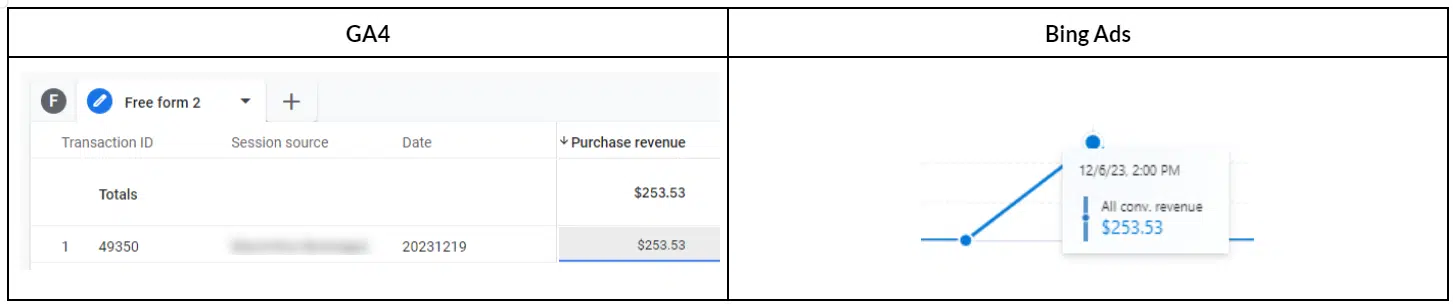
The corporate had a purchase order for $253.53. In GA4, the session supply for this conversion on 12/14 was an e-mail advertising marketing campaign.
Nevertheless, in Microsoft Advertisements, the identical buy occasion was tracked by the pixel and attributed to the unique Microsoft Advert, which the customer clicked on 12/6, though the customer didn’t buy till after the e-mail on 12/14.
Microsoft Advertisements’ pixel claims the acquisition conversion wholly for Microsoft Advertisements as a result of the pixel doesn’t have the holistic view we’ve in GA4, the place we monitor a number of channels’ efficiency.
Whereas the advert contributed to the conversion, it was not in the end the final contact channel. In actuality, Microsoft Advertisements ought to possible solely have 50% of the credit score for this buy, however as a result of the pixel can’t see all the knowledge, it attributes 100% of the credit score to Microsoft Advertisements.
If we spent $126.77 on the marketing campaign and generated the reported $253.53 in income, then our ROAS is 200%. But when we have been monitoring and attributing the sale to solely give 50% to the Microsoft Advert, then the precise ROAS would solely be 100%.
So, if our bid technique is a goal ROAS of 200%, the pixel assumes we’ve met this threshold when maybe we’ve not.
Whereas it is a easy, two-step buyer journey, many buyer journeys are rather more complicated, with a number of steps in between.
Moreover, in case your group doesn’t use a single supply of fact (SSOT), resembling GA4, for reporting, then every channel supervisor could attribute the identical conversions to their channel.
In our shopper instance, the Microsoft Advertisements supervisor and the e-mail supervisor would each rely this single buy as $253.53 in income for a complete throughout each platforms of $597.06 in income generated, which won’t match our precise buy income.
Dig deeper: Tracking in 2024: Where we are and how to prep
Third-party cookie monitoring is being phased out
Advert platform cookies are thought of third-party cookies as a result of they don’t seem to be cookies generated instantly by your web site.
To turn into extra compliant with varied privateness legal guidelines, Google is within the strategy of phasing out third-party cookie tracking.
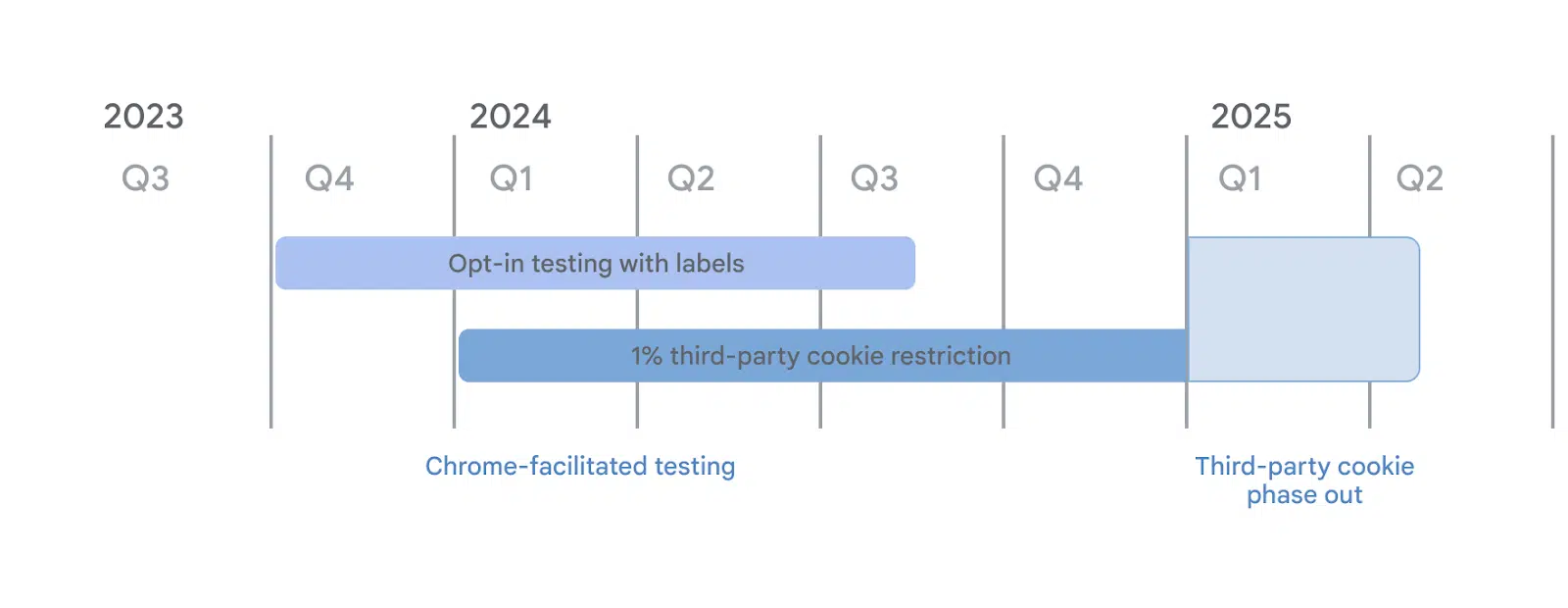
Whereas cookie monitoring hasn’t all the time offered probably the most correct knowledge, it’s been the workhorse we’ve relied on as digital entrepreneurs. Nevertheless, there’s a brand new possibility your group must be transferring to now, forward of the cookie phase-out, to make sure knowledge continuity and accuracy.
Conversion APIs repair cookie monitoring inaccuracy
For those who promote on Google, Fb, LinkedIn, TikTok, Pinterest or Snapchat, you’ll have seen their makes an attempt to have advertisers undertake their conversion APIs.
Not like third-party cookies, which depend on the browser to set and be learn, conversion API-based monitoring sends person data instantly from the platform’s server.
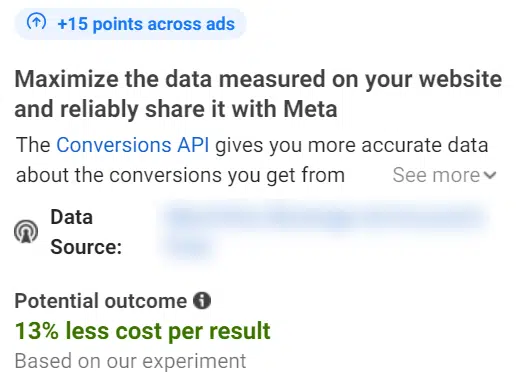
Because the conversion API technique works on the server aspect and doesn’t depend on the browser, it will possibly present extra correct knowledge as a result of it doesn’t face sure limitations, resembling advert and cookie blocking software program and the tunnel imaginative and prescient that pixel monitoring incurs.
Getting the information proper
Your group can take two most important steps now to shore up your conversion knowledge with advert platforms.
- First, audit your adverts to make sure that customers are tagging and monitoring conversions appropriately. Search for frequent missteps, just like the Google Advertisements buy instance.
- Second, convert to the conversion API (CAPI) technique. Implementing CAPI is usually a bit technical, so it’s possible you’ll want your net developer to help.
Contributing authors are invited to create content material for Search Engine Land and are chosen for his or her experience and contribution to the search group. Our contributors work below the oversight of the editorial staff and contributions are checked for high quality and relevance to our readers. The opinions they categorical are their very own.
