


Schema markup (aka structured information) is a sort of code that helps web sites talk extra clearly with engines like google. On this newbie’s information, we’ll go over how you can implement it appropriately, how you can audit it, and why it’s vital.
Communication is the important thing to each wholesome relationship; even between a search engine and your web site.
Enter: Schema markup, a particular language that helps crawlers like Google rapidly decide the kind of content material they’re about to learn.
Whereas it’s not obligatory, including this code to the backend of your website can enhance your model authority, consciousness, and place on the search engine outcomes web page (SERP).
In different phrases, it’s a fairly stable means to enhance search engine marketing (search engine marketing).
However understanding what sort of schema markup to make use of (and the place to place it) is essential — and that is the place a schema markup audit comes into play.
What’s schema markup?
Schema markup is a sort of code that helps web sites talk extra clearly with any and all engines like google (Google, Bing, Yandex, and so forth.).
This language, additionally referred to as structured data, permits engines like google to categorize content material effectively, which regularly means wealthy outcomes:
Wealthy outcomes for native enterprise. (Picture: Screenshot)
Utilizing schema markup (appropriately) in your website may help your webpages:
- Talk with engines like google
- Rank increased within the SERP
- Take up extra actual property on SERPs with wealthy snippets
- Seem on Google’s Knowledge Graph
What’s extra, it might supply extra management over your model look, assist optimize for voice assistants, and enhance your semantic construction and technique.
What schema markup is not
Schema markup is not a requirement. (Nope, you received’t be penalized by Google for those who don’t use it.)
Neither is it an search engine marketing “hack.” It is, nonetheless, a missed alternative for extra visibility for those who don’t implement it.
See, structured information vocabulary helps your search engine marketing the identical means high quality content material assists your search engine marketing. You possibly can’t “work the system,” however you should utilize it to your benefit.
How schema markup works
Consider schema markup as little labels all through your web site.
These “labels” (i.e. snippets of code) are pasted into the backend of sure webpages and assist engines like google higher perceive what sort of web page content material they’re about to crawl — suppose “recipe web page,” “homepage,” “FAQs,” “weblog or article,” and “native enterprise info.”
That means, crawlers like Google can extra simply perceive the content material and acknowledge the way it needs to be displayed on the search engine outcomes web page (SERP).
The excellent news is you don’t should be a grasp coder so as to add schema markup to your web site, because of Schema.org.
This on-line library homes a protracted listing of net web page classes, frequent properties that exist on these forms of pages, and a common code that acts as a “label” for these related web page varieties.
This language (code) may be pasted into your website for all engines like google to learn and perceive.
Right here’s the kicker: This on-line useful resource was based and developed via the shocking collaboration of Google, Microsoft, Yahoo, and Yandex.
Whereas schema markup is the “frequent language,” there are three schema encoding varieties to select from. Consider this as regional dialects inside america.
Certain, English is the frequent language — however everyone knows issues sound fairly completely different from the Midwest to the South, for instance.
These three encoding varieties embrace:
- Useful resource Descriptive Framework in Attributes (RDFa)
- Microdata
- Javascript Object Notation for Linked Objects (JSON-LD) – which is Google’s advisable coding sort
What does schema markup appear to be?
Whereas a regular search outcome reveals the title tag, meta description, and URL, schema markup may help you get wealthy outcomes (or featured snippets), these enticing outcomes with further visuals, interactive options, and aptitude.
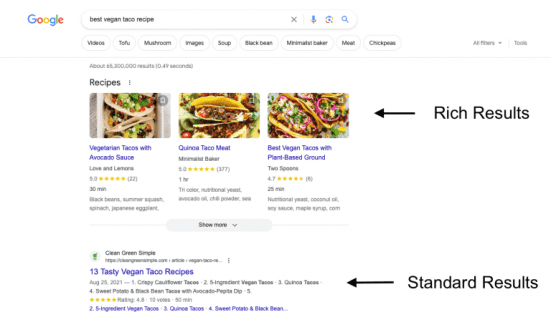
(Picture: Google SERP screenshot)
Bear in mind: Wealthy outcomes are completely different from featured snippets. Whereas wealthy outcomes are the results of directions given to a search engine by your web site.
Featured snippets are extractions from content material that Google deems most related and helpful to the search question, usually sitting at place zero.
Consider it as a useful information saying, “Hey, Google, this webpage is a couple of recipe. Right here’s the recipe title, scores, components, cooking time, and a photograph to incorporate within the outcomes.”
On the backend facet of issues, schema markup seems to be rather less aesthetically pleasing and a bit of extra like code:
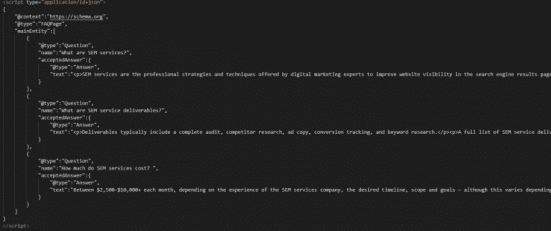
(Picture: Screenshot)
Forms of schema markup
Very similar to a library or a file retailer the place a lot of works are organized by style, most webpages may be sorted into frequent classes — i.e. schema varieties.
For instance, an internet site like Minimalist Baker would use “recipe” schema markup varieties for nearly all of their webpages. Recipe schemas have sections for components, cooking directions, prep time, and evaluations or star scores.
When a search engine sees this specific schema sort, it understands the web page is a recipe and may present a preview within the search outcomes.

(Picture: Screenshot)
Whereas there are over 800 forms of schema markup, Schema.org lists the next as some generally used varieties:
- Artistic works (i.e. e-book, film, music recording, recipe, or TV sequence)
- Embedded non-text objects (i.e. audio, picture, or video)
- Breadcrumb schema
- Occasion
- Well being and medical varieties
- Group
- Individual
- Place, native enterprise, restaurant
- Product or supply
- Evaluation
- Motion
There’s a full listing of structured information varieties you should utilize for markup (examine ‘em out on schema.org).
Figuring out what forms of schema markup make sense in your web site is step one of implementing schema markup — and one of many main targets of a structured information audit.
What’s a schema markup audit?
A schema markup audit is the method of scanning via each web page on the backend of your web site to search out:
- What structured information is already on the location
- If there are any errors or points that exist with the info discovered
- What alternatives exist (i.e. structured information that may be lacking)
And, in fact, no audit is full with no plan for implementation. The aim of an audit is to be sure to have the perfect schema varieties obtainable in your web site.
Conducting a schema markup audit helps establish how your web site might talk extra clearly — and maximize all of your search engine marketing (search engine marketing) efforts to enhance your natural site visitors and, finally, conversions.

(Picture: Unsplash)
What you’ll want in your schema audit
An audit usually requires two software program functions:
- Google Search Console
- A paid device like SiteBulb, Screaming Frog, or SEMRush
Auditing your schema markup with Google Search Console

(Picture: Google Search Console screenshot)
Google Search Console (GSC) doesn’t report on all schema varieties, nevertheless it does present you any errors which may exist.
Right here’s how:
Log in to your Google Search Console and select “Enhancements” from the left sidebar.
You’ll see an inventory of errors and warnings. From there, you’ll be pointed to pages which can be presently affected by the problems. Invalid errors seem in purple textual content.
For extra details about structured information in your pages, you should utilize Google’s URL Inspection Tool and Structured Data Testing Tool. This a part of the audit course of is free.
Auditing your schema markup with a paid device
Whereas Screaming Frog isn’t free, this crawling device has numerous advantages — together with a complete schema markup audit.
This device will present all the info you want for schema markup evaluation, together with lacking structured information, validation errors, validation warnings, and parse errors in addition to Microdata, JSON-LD, and RDFa URLs.
Whew.
In the event you determine to spend money on Screaming Frog, you possibly can audit your schema markup by taking these straightforward steps:
- Click on Configuration > Spider
- Select the “extraction” tab
- Scroll right down to “structured information”
- Examine all of the containers
Then, run the crawling function.
Semrush is one other device we advocate that has a website audit device that can assist you uncover errors inside your website.
Auditing your schema markup with SiteBulb
One other paid device (with a free trial) that may assist with a schema markup audit is SiteBulb. It could present beneficial details about your structured information and supply insights into coping with current issues.
Within the “Audit Information” part, choose the “structured information” slider. When the device finishes crawling your web site, select “structured information” below “all hints.”
If the device finds structured information that doesn’t adjust to Schema.org, it is going to return validation errors. Together with the error message, you’ll get error particulars, hyperlinks to related sources, and recommendation that will help you take care of the issue.
Lastly, use testing tools on a per-page foundation. The Rich Results Test tool helps decide what wealthy outcomes may be generated in your web page.
And you should utilize the Schema Markup Validator to check forms of https://schema.org markup — with out Google-specific validation.
Hole evaluation and competitor evaluation
Utilizing these auditing instruments, you’ll get a good suggestion of any errors that exist in your website. However there are some handbook steps you need to take as effectively.
Try schema.org’s list of available schema types. Whilst you learn via the listing, suppose again to your personal website. Do any of the schema varieties listed resonate along with your content material? Are you lacking alternatives so as to add schema markup?
Or possibly you’re lacking content material altogether that needs to be added to your website (with a bit of schema markup love added as soon as it’s stay).
Consider this a part of your schema audit as a content material creation alternative.
Whilst you’re at it, check out what your competitors rank for in snippets and make it a precedence to beat ‘em.
Right here’s a straightforward place to start out:
- Ecommerce can usually implement product and assessment schema
- Lead technology can usually implement assessment schema
- Each ought to implement a business-type schema
- If FAQs or how-tos exist, mark these up as effectively
After you utilize your auditing device to evaluate your present structured information markup, you will get to the implementation course of.
Learn how to implement schema onto your website
Relying in your content material administration system (CMS), comparable to WordPress and Joomla, there are plugins you should utilize to implement your schema markup simply and rapidly, even for those who don’t have site owners that will help you.
You may as well write scripts manually and implement by way of HTML tags.
Want a bit of assist? You should utilize a schema markup generator! For instance, Google’s structured data markup helper provides you a hand in including structured information markup to a pattern webpage.
Regardless of the way you implement the code, make sure you examine them along with your testing instruments.
Relying on the forms of schema you implement, it ought to pop up inside GSC as soon as crawled by Google.
Bear in mind, GSC doesn’t let you know in case you are rating for a snippet — simply that the markup was discovered and processed. You’ll want to observe with instruments like Semrush for precise outcomes.
How usually to conduct a schema markup audit
A schema markup audit needs to be a part of your common SEO audit and carried out early on to find out what sort of schema needs to be included in your web site.
Relying on the kind of web site you might have, you want to contemplate working these audits at the very least twice a 12 months. That stated, ecommerce web sites could have to do it extra usually (about each three months).
Listed here are just a few causes to rearrange an audit forward of schedule:
- Poor search engine marketing outcomes
In case your search engine marketing efforts aren’t yielding the specified outcomes, chances are you’ll wish to run a schema markup earlier than it’s scheduled.
- Google algorithm replace
It’s additionally a good suggestion to run an audit after a core Google algorithm update. Whereas Google doesn’t affirm that schema markup is a direct rating issue, it might change its thoughts at any time.
- Wealthy snippets
Needless to say schema markup improves the looks of wealthy snippets. In the event you aren’t pleased with what they appear to be on the SERPs, chances are you’ll have to assessment the structured information.
Can schema markup truly harm search engine marketing?
Whereas the advantages of schema markup for SEO is hardly a secret (as mentioned above), it’s solely truthful to present the total image right here:
There might (possibly?) be some potential drawbacks to utilizing schema markup relating to technical search engine marketing. There’s a slight probability that the more snippets you have, the lower your click-through rate (CTR).
Why? As a result of, in concept, all the data a searcher wants is (usually) featured in that single snippet on the SERP.
However that additionally means enhanced snippets usually tend to enhance your model consciousness. And whereas Google refuses to name it a rating issue, digital entrepreneurs agree it’s integral to optimizing your search engine marketing efforts.
Because of this conducting common markup audits ensures the integrity and effectiveness of structured information by validating the standard of your code and ensuring it’s stay on all related pages.
The takeaway
Schema markup audits are crucial to make sure the success of your search engine marketing efforts and push them to the restrict. They may help you establish errors that forestall main engines like google from indexing your web site appropriately.
Even for those who’re glad along with your advertising and marketing outcomes, you continue to have to audit structured information at the very least annually.
Each free and paid instruments exist to assist simplify schema markup audits. But when conducting your personal audit feels daunting, we may help — simply reach out.
This text has been up to date and was initially revealed in October 2022.
FAQs
Why is schema markup vital?
Schema markup and search engine marketing go hand-in-hand. By enhancing how engines like google interpret your content material, schema markup can result in enhanced search outcomes comparable to:
- Wealthy snippets
- Data panels
- Improved click-through charges
Whereas it doesn’t instantly have an effect on the rankings themselves, it might enhance consumer expertise and visibility.
Can I check to ensure my schema markup is applied appropriately?
Sure! For instance, Google’s Wealthy Outcomes Take a look at and Google’s Structured Information Testing Instrument can validate your schema markup.
These instruments present how your schema will seem in search outcomes, and notifies you of any errors.
What are some frequent errors when implementing schema markup?
Frequent errors embrace:
- Utilizing schema varieties that don’t match the content material
- Not updating the markup with content material adjustments
- Incorrect or incomplete markup
- Failing to check the markup for errors
Can I take advantage of schema markup for native search engine marketing?
Sure, it may be very useful for native search engine marketing! For example, utilizing Native Enterprise schema may help engines like google show enterprise particulars like handle, telephone quantity, hours, and even social media in native search outcomes.
Is there a restrict to how a lot schema markup I can use on one web page?
No, there’s not a restrict. Nonetheless, it’s vital so as to add solely related and correct schema markup to your pages.
Overdoing it with numerous pointless or incorrect information can result in errors (and doubtlessly confuse search engine crawlers).
